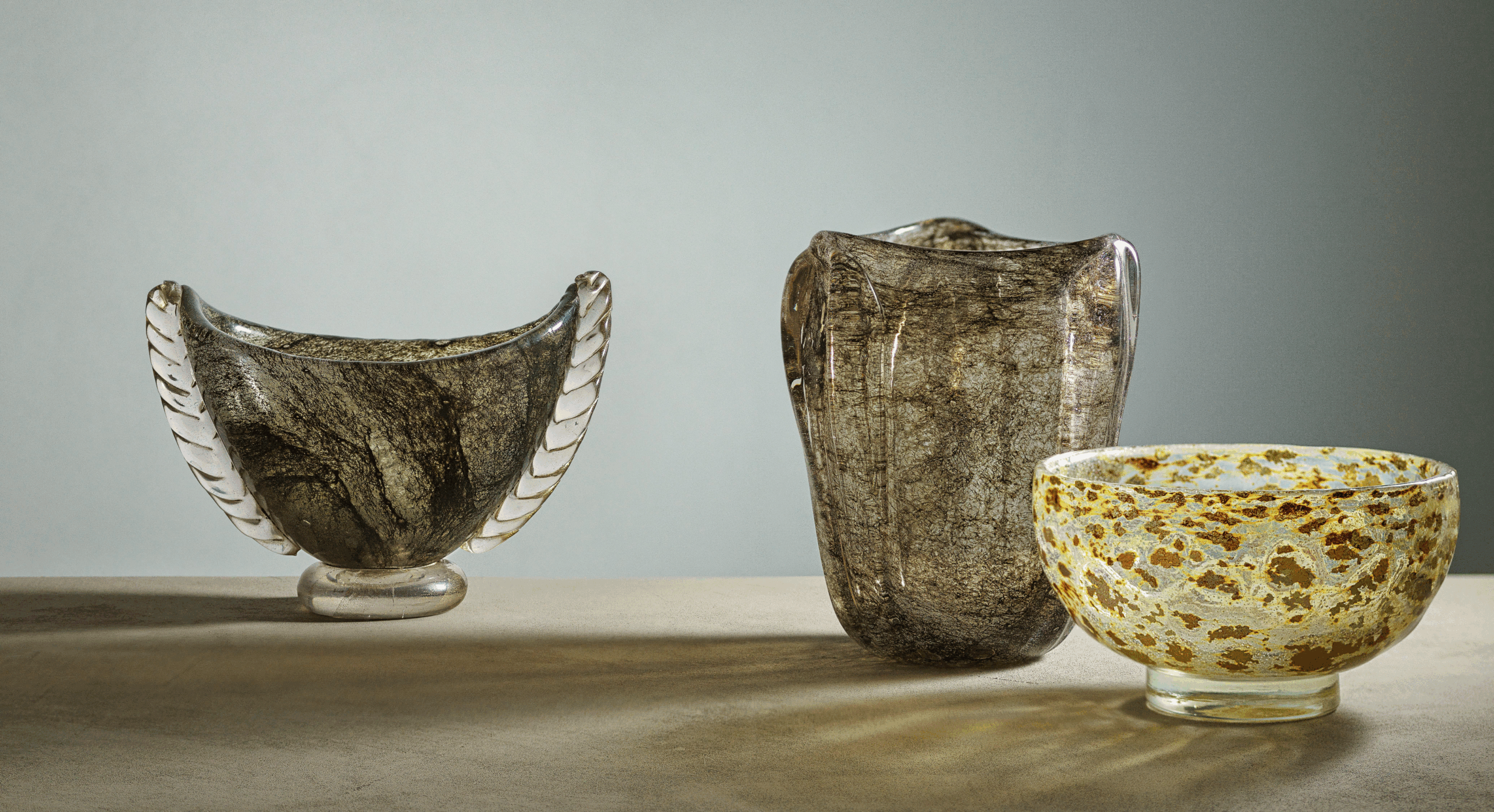
Vasi crepuscolo e coppa autunno gemmato, E. Barovier, Ferro Toso-Barovier, 1935-36, collezione L. H. Holtz; collezione Galleria M. Heiremans, Anversa. Ph. Enrico Fiorese

Vasi crepuscolo e coppa autunno gemmato, E. Barovier, Ferro Toso-Barovier, 1935-36, collezione L. H. Holtz; collezione Galleria M. Heiremans, Anversa. Ph. Enrico Fiorese
In line with the second exhibition chapter, situated at LE STANZE DEL VETRO on the evolution of Murano’s activity and production at the Venice Biennale in the decade 1932-1942, the Glass Study Center is organizing its usual annual conference. It focus on themes and dynamics during the period in question, thanks in part to the international openness that the lagoon events allowed for experimental progress in glass art in that juncture of time.
In fact, 1932 represented a sort of significant watershed, considering that from that year onwards, for the first time, the International Institution decided to dedicate an autonomous section to Murano glass, giving it a designated space and considerable visibility.
The protagonist of this conceptual and programmatic shift was the then Secretary General Antonio Maraini, who involved architect Brenno Del Giudice in designing and building the Venice Pavilion. An architectural idea that was as coherent as it was functional in terms of promoting the decorative arts, thus also expanding the gardens of the Biennale itself.
This was a forward-looking operation that immediately launched a period of remarkable creativity and experimental momentum, which was unfortunately brought to an abrupt halt in 1942 by the Second World War.
It is precisely thanks to this extraordinary artistic fervor of national and international scope, aided by the synergies between prestigious glassworks and artists and designers of great depth—such as Ercole Barovier, Pietro Chiesa, Flavio Poli, Carlo Scarpa, and Vittorio Zecchin—that experts in glass and decorative arts will explore the context and taste of the design evolution. It was developed both in contemporary, in France, and through other displaying venues, including the Triennale di Milano.
A continuously growing ferment that will mark a decisive leap in quality in the glass art sector, above all thanks to the numerous opportunities for exchange and the expansion of the global collectors’ market, which is, now and then, always open to revisited technical solutions and innovative methods.
The conference will be preceded on Wednesday 5 November by the presentation of the Quaderni del Vetro series, which in this second edition pays tribute to international artists Cristiano Bianchin, Silvano Rubino and Giorgio Vigna. On this occasion, their respective digital archives will be published on the Fondazione Giorgio Cini website, putting approximately 3,500 items online, including photographs, drawings and sketches, accompanied by the relevant catalogue entries.
PROGRAMME

Presentazione collana Quaderni del Vetro
Saluti istituzionali
Luca Massimo Barbero
Direttore dell’Istituto di Storia dell’Arte, Fondazione Giorgio Cini
Paola Cordera
Verre-en-valise: un repertorio per la modernità
Debora Rossi e Lia Durante
Un racconto, attraverso i documenti dell’ASAC, sulla presenza delle arti decorative alla Biennale
Giovanni Bianchi
Il mosaico a Venezia nella prima metà del Novecento, tra produzione e promozione
Carla Sonego
Ricerche e sperimentazioni alla Biennale (1932-1942): Carlo Scarpa ed Ercole Barovier
Rosa Chiesa
Il vetro e Milano
Jean-Luc Olivié
What happened to glass in France between 1932 and 1942?
Lucia Mannini
Dai vetri alle lacche: Pietro Chiesa e le presenze straniere nel Padiglione Venezia alle Biennali 1932-1936
Vasi crepuscolo e coppa autunno gemmato, E. Barovier, Ferro Toso-Barovier, 1935-36, collezione L. H. Holtz; collezione Galleria M. Heiremans, Anversa. Ph. Enrico Fiorese

