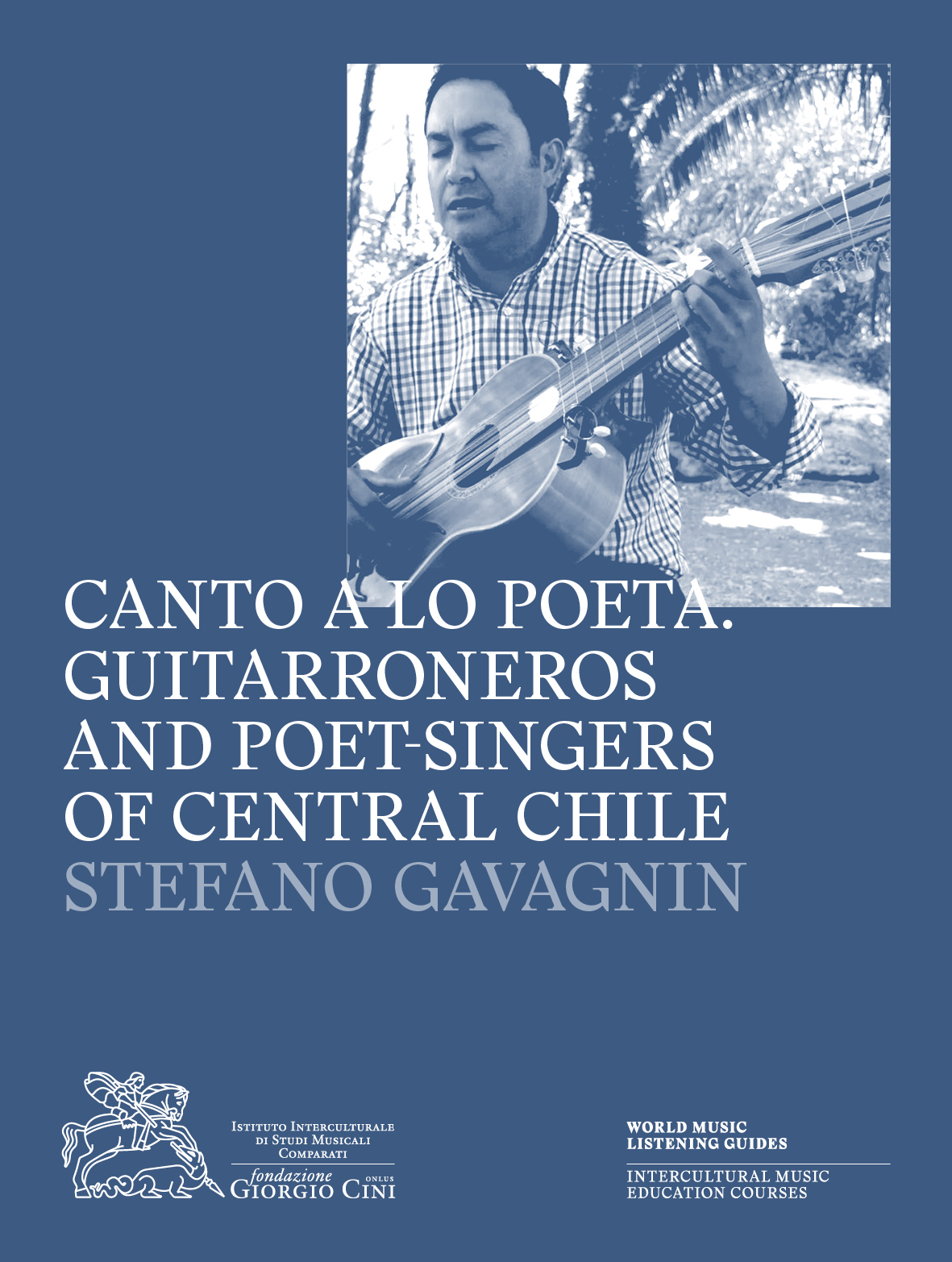
Canto a lo poeta. Guitarroneros and Poet-Singers of Central Cile
The second edition of the editorial series World Music Listening Guides. Intercultural Music Education Courses, the guide Canto a lo poeta. Guitarroneros and Singers from Central Chile, by Stefano Gavagnin, is dedicated to the vocal and instrumental repertoires of Chilean canto a lo poeta. The materials it comprises were collected during the recording for the fourth edition of Zoom in on Masters (IISMC), published online in 2021 and devoted to the guitarroneros and singers of Central Chile. Its realisation was made possible thanks to the valuable contribution and generous collaboration of the singers Erick Gil and Roberto Carreño, as well as the ethnomusicologist Claudio Mercado of the Museo Chileno de Arte Precolombino. The materials presented in this guide are organised so as to provide first a broad contextualisation of the practice of canto a lo poeta, before progressively focusing on aspects concerning the performance practice of music and sung verse. An initial distinction between the two different types of repertoire – canto a lo divino, of a religious nature, and canto a lo humano, secular and profane – is introduced through a video in which the two poet-singers, Roberto Carreño and Erick Gil Cornejo, perform a short example accompanying themselves on the characteristic Chilean guitarrón and on a guitar with specific ‘transposed’ tunings. Particular attention is given to the description of the organological features and cultural meanings associated with these instruments: in a brief video interview, Roberto Carreño discusses the roles and functions of the guitar in rural Chile, while a video animation, created from a live performance by the two musicians, illustrates the main performance techniques of instrumental accompaniment with the guitarrón and the guitarra traspuesta. As is often the case, the practice of canto a lo poeta has not remained static over time. A significant section of the guide compares traditional performance contexts with contemporary transformations.