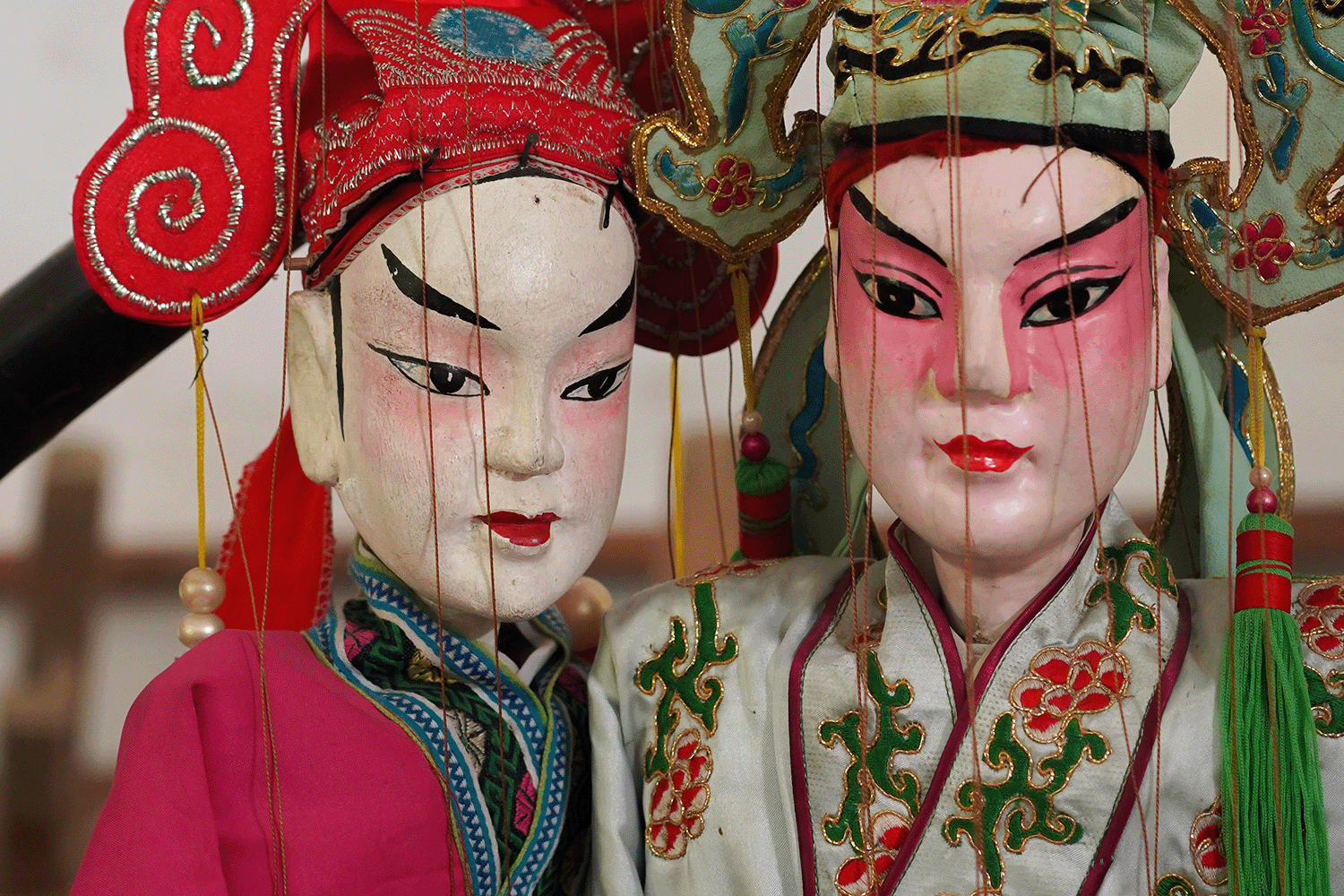
Chinese Marionette Performance | Rituals, Myths and Music of Eastern China

The Intercultural Institute of Comparative Music Studies stages the tradition of string-operated puppet theatre, an art form deeply rooted in the culture of Zhejiang province and recognised as an intangible cultural heritage of the People’s Republic of China. The performance, curated by the Shuangfeng (Double Phoenix) Company from Rui’An, Municipality of Wenzhou, China, is divided into four parts, designed to allow the audience to explore the diverse artistic and sonic possibilities of Eastern Chinese puppet theatre.
This type of performance is part of the broader Chinese theatre system, which combines ritual practices, dramaturgical expression, and popular traditions, and is particularly linked to Taoist heritage. String-operated puppet theatre in Eastern China represents a performative form of high technical value, in which the skill of the puppeteer is central to creating a fluid interaction between the inanimate object, narrative expression, and musical accompaniment. The complexity of performance is reflected in the close synchronisation of movements and dialogue, where puppeteers work in synergy with musicians performing on traditional Chinese instruments such as the suona (Chinese oboe), pipa (four-stringed lute), dizi (bamboo flute), and a variety of percussion instruments including gongs and drums, collectively known as luogu.
The project, curated by Francesco Serratore (Zhejiang Conservatory of Music), also includes a meeting on 4 November between the Chinese artists and students of Ca’ Foscari University, entitled Il teatro di figura nella Cina orientale: analisi culturale e delle pratiche performative. This represents an important opportunity for in-depth study and research on puppet theatre in Eastern China, with significant implications for the study of intangible cultural heritage, traditional music, and language preservation.
The event is realised with the support of the Wenzhou Municipal Bureau of Culture, Radio, Television, Tourism and Sport; the Communication Department of the Wenzhou Municipal Committee; the Rui’An Bureau of Culture, Radio, Television, Tourism and Sport; and the Rui’An Association for the Safeguarding of Intangible Cultural Heritage, in collaboration with Ca’ Foscari University of Venice, Department of Asian and North African Studies; the Antonio Pasqualino International Puppet Museum; and A.N.G.I., the New Italian-Chinese Generation Association.
The Performance

The performance is structured in four parts, each designed to highlight the multiple artistic and sonic possibilities of Eastern Chinese puppet theatre. The opening piece is performed by the chuida ensemble (winds and percussion), traditionally used to announce the beginning of the performance. This is followed by a depiction of the Eight Taoist Immortals, each represented with their own symbols and powers, in a scene of great scenic and spiritual value, accompanied by auspicious verses and the rhythms of gongs and drums. The third part presents scenes inspired by the local Wenzhou opera, Ouju, in which heterophonic melodies of string and bamboo flute instruments intertwine with male and female singing, demonstrating the expressive potential of puppet theatre within operatic storytelling. The finale captivates the audience with the acrobatics of the true and false Sun Wukong, the Monkey King, whose feats, performed to the driving rhythm of the percussion, culminate in an explosion of energy and spectacle, bringing the performance to a visually and sonically striking conclusion.
- «五更头通» Toutong of the Five Geng
A festive and auspicious opening piece, performed exclusively on the suona and luogu (gongs and drums). The piercing sound of the suona, together with the insistent rhythms of the gongs and drums, symbolises the transition from night to dawn, carrying wishes of renewal and prosperity. This piece is traditionally used to open performances, signalling the imminent start of the show to the audience.
- «三星八仙庆贺» The Three Stars and the Eight Immortals Celebrate
The invocation of the Eight Taoist Immortals is an essential part of the ritual performance repertoire. It is an auspicious scene in which Taoist deities and the benevolent spirits of the three stars (Fortune, Longevity, and Wealth) summon various spirits and deities, make offerings, and bow together in harmony to Heaven and Earth to ensure favourable weather, national peace, and prosperity. This is an ode to harmony and prosperity, conveyed through traditional poetic language and accompanied by the chuida ensemble (winds and percussion).
- «杨正明封官起程» Yang Zhengming Receives his Appointment and Departs for his Post
Yang Zhengming was a filial and talented young man who achieved third place in the imperial examination. The story narrates key moments in his life, culminating in his appointment as Governor of Yanghe. The tale is presented in the style of Wenzhou Ouju opera, featuring a type of rasping vocalisation contrasted with the delicate and evocative heterophony of sizhou (silk and bamboo) accompaniment. The scene expresses core Confucian values — virtue, honour, and family harmony.
- «真假美猴王» The True and False Monkey King
Inspired by a famous episode from Journey to the West, an epic-mythological narrative frequently adapted for theatre, this scene depicts the trials faced by the Monkey King when travelling to India to bring Buddhist scriptures to China. It portrays the conflict between the true Sun Wukong and his deceptive double. With a driving rhythm, acrobatics, and witty dialogue, the performance explores themes of truth and illusion, loyalty, and discernment. A classic of traditional Chinese theatre, it combines acting skill, technical virtuosity, and moral symbolism, concluding the performance in a triumph of energy and colour.
The Company
The Shuangfeng Company was founded in 1989 by Wu Yanyao, now the representative of the fourth generation of puppeteers in the Wu family.
Shuangfeng (Double Phoenix) Company (Rui’An, Municipality of Wenzhou, China)
Wu Yanyao Director, Principal Puppeteer, Male Voice
Liu Huazheng Suona, Dizi, Banhu
Wu Yanbiao Music Director, Dagu and Biangu Drums
Yang Suifang Second Puppeteer, Female Voice, Small Gong
Lai Sangai Banhu, Erhu, Suona
Free admission until full capacity

