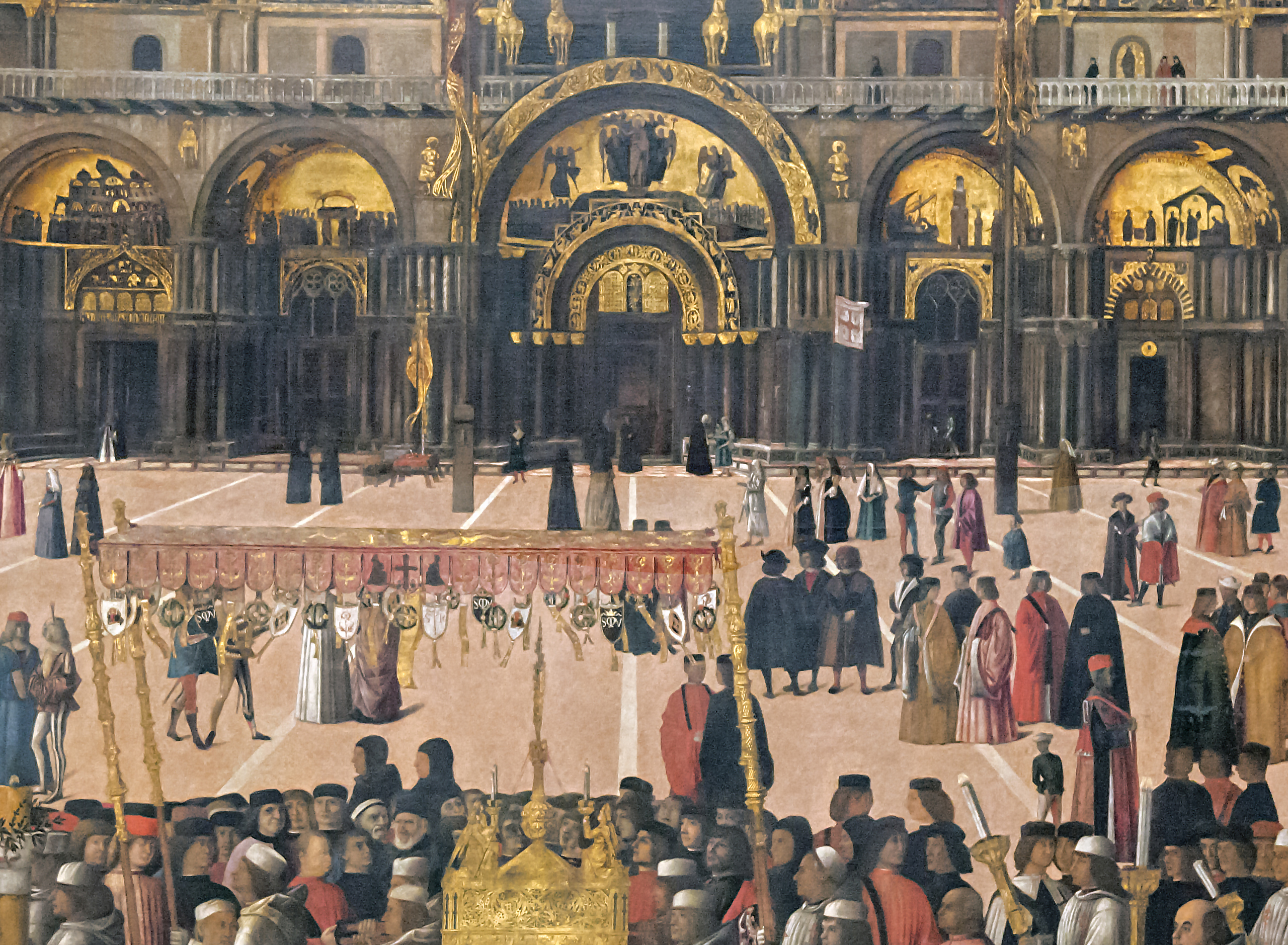
Gentile Bellini, Processione in Piazza S. San Marco (1429 - 1507), Gallerie dell'Accademia, Venezia

Gentile Bellini, Processione in Piazza S. San Marco (1429 - 1507), Gallerie dell'Accademia, Venezia
Kapellmeister at the Basilica of St Mark from 1527 until his death (1562), Adrian Willaert was one of the most authoritative, prolific and influential composers of the central decades of sixteenth-century Europe. Willaert was also a teacher, and his disciples included some of the best-known composers and theorists of the time, such as Nicola Vicentino, Costanzo Porta, Cipriano de Rore and Gioseffo Zarlino.
The last two succeeded the maestro in the prestigious position at the Marciana, so Willaert is generally considered the founder of the ‘Venetian school’. Of his vast oeuvre, we examine a group of madrigals published in his collection Musica nova (Venice: Gardano, 1559), which feature sonnets from Petrarch’s Canzoniere, with a view to comparing them to two examples of liturgical polyphony by the same composer: the respective Kyrie of the Mente tota masses (1512–17) and Mittit ad Virginem (ca. 1560), among the final works of his life.
This comparison allows us to observe the longevity of Petrarch’s fortune among sixteenth-century madrigalists in the Po Valley and Venice, and to assess the relationship between their work and Zarlini’s new theories on the expressiveness of melodic intervals.
Gentile Bellini, Processione in Piazza S. San Marco (1429 - 1507), Gallerie dell'Accademia, Venezia

