Marriage Chest
The piece, of Florentine manufacture dating to the second quarter of the 14 th century, is made of poplar wood and measures 52 x 144 x 58,5 cm.
The lid is slightly domed and reinforced by flatten iron bands which divide the front into five panels. Each panel represents two superimposed scenes executed in slight relief, alternating against grounds of red and blue. The decorated scenes reprise themes codified in courtly tradition and very common in nuptial iconography. One can observe the young man and the lady on the sides of the Fontana d’Amore (Fountain of Love) and then the crowned knight on horseback, now holding a whip, now holding a sceptre.
On either side of the central lock, two shields with the family coats of arms: one unfortunately illegible, the other identifiable as the crest of the Del Riccio family, confirming the Florentine origin of the piece. The short sides of the chest are embellished with floral motifs, again in slight relief and on red backgrounds alternating with blue ones. On the lid, traces of the original pastiglia decoration are still visible.
The restoration, completed in 2025, was conducted thanks to Save Venice Inc. and Christopher Todd Page, under the supervision of the Soprintendenza Archeologia Belle Arti e Paesaggio per il Comune di Venezia e Laguna (Office for the Protection of Architectural, Natural, Historic, Artistic and Ethno-Anthropological Heritages in Venice and Its Lagoon).
THE HISTORY
The chest entered the Cini Collection from the collection of Anna Maria di Bosco by 1940 and was then placed in the Castle of Monselice. Subsequently, it was kept in the Gallery of Palazzo Cini at San Vio, in the Sala dei Primitivi (Room of the Primitives).
THE RESTORATION
During the analysis, some damaged areas were identified, specifically on the lid and the base, due to a significant infestation of wood-boring insects. In addition to the presence of large, deteriorated metal nails, and the subsequent loss of wooden material, further issues concerning the painting layer and various more losses concealed by coarse fills and by pictorial retouchings that have since been altered.
After phases of disinfestation, repair and consolidation of the compromised and degraded wooden and metal elements, there followed a very complex phase of surface-cleaning which removed all of the maintenance varnishes and the altered retouchings, without affecting the early-20 th -century reconstruction since it had been executed to an excellent standard; then, the intervention of retouching and chromatic calibration and the final
varnishing. Operations were preceded by appropriate stratigraphic analysis, aimed at determining the composition of the pigments, binders and the reconstructions.
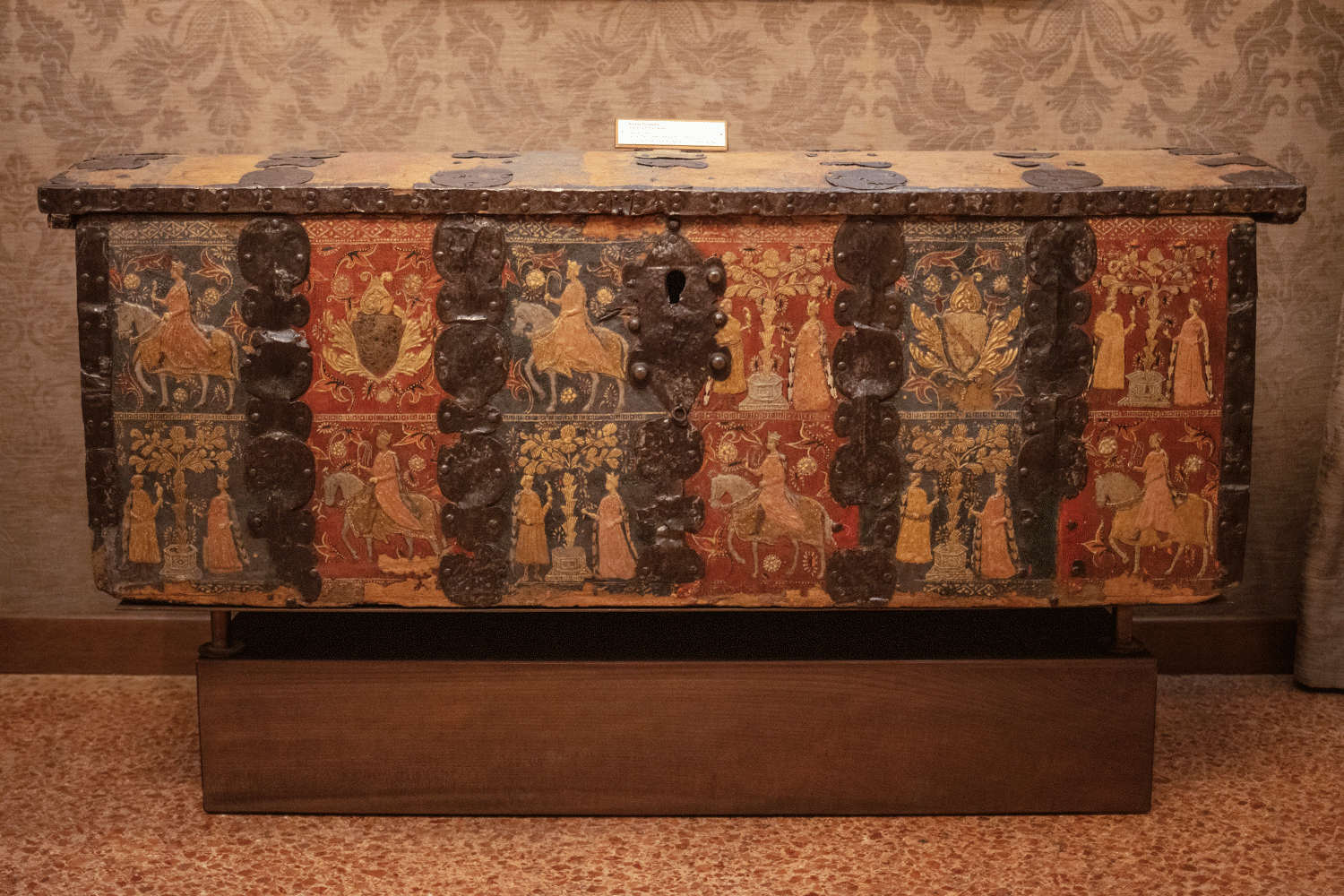
Manifattura fiorentina, Cassone nuziale (Amanti alla fontana d’Amore e cavalieri), Ultimo quarto del XIV secolo, Palazzo Cini. La Galleria.

