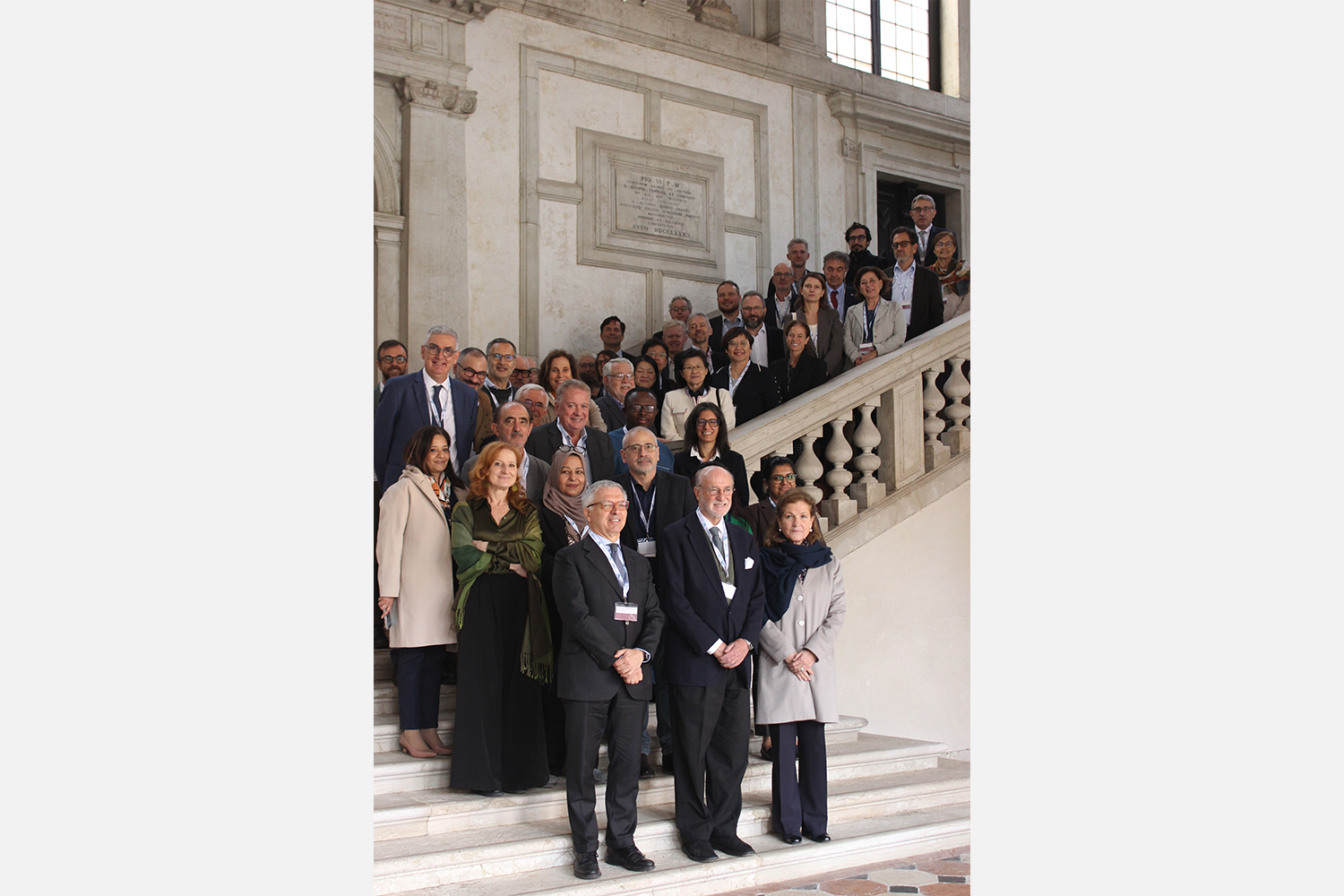

The Fondazione Giorgio Cini has always been committed to promoting dialogue between the humanities and sciences and is recognized as a place for reflection on global issues. With the symposium Global Health in the Age of AI: Charting a Course for Ethical Implementation and Societal Benefit, organized last November, it renewed this commitment, inaugurating a new cycle of international meetings to facilitate the identification of solutions to the challenges of the contemporary world.
This year, the conference Democracy and Pandemics aims to explore how democracies can address the challenge of pandemics, approaching the topic from an interdisciplinary perspective.
This discussion, edited by Daniele Franco in collaboration with Michela Maguolo, explores key issues: from prevention to crisis management, from striking a balance between individual freedoms and the protection of the community, to questions of equity in access to care. The common thread running through all the contributions is the conviction that dialogue—between fields of knowledge, between institutions, and between countries—is essential for developing responses that are up to the task of addressing global challenges.
As emerged in 2020 with Covid-19, a pandemic raises issues that require a comprehensive response: health, scientific, industrial, and organizational.
The whole of society needs to be involved: the state, local authorities, businesses, and volunteers; citizens and families need to be involved in decisions on social distancing and prevention.
In a highly connected world, there also needs to be extensive collaboration between countries in prevention, research, and crisis management mechanisms.
The political and ethical issues are clear: how to reconcile the needs of the community with individual freedom of choice; how to inform citizens quickly and effectively while ensuring freedom of expression and criticism of government action.
Equity issues are also pressing: how to define those deserving priority assistance in the emergency phase; how to avoid disparities in care and vaccination capabilities, both nationally and internationally.
The risk of future pandemics in a highly connected world is always latent. It must be addressed through prevention and preparedness, which must also extend to legal, informational, and ethical issues.
Reflection is needed that must extend to as wide a sphere of public opinion as possible. The health issue is also a cultural issue that engages the whole of society.
The symposium brings together experts from many countries in the fieldsof medicine, biology, economics, politics, sociology, philosophy, and law. They work in national public institutions, international organizations, private foundations, universities, research institutions, and scientific journals.
The meeting is divided into three sessions (dedicated respectively to health, international, and political aspects) and aims to be an opportunity for interdisciplinary dialogue between individuals who play a prominent role in the international debate.
The proceedings of the symposium will soon be available in Quaderno di San Giorgio No. 40. Along with the video presentations, the Quaderno will offer data and insights for a thorough and critical examination of one of the most important global issues that affects us all.
Daniele Franco
Scientific Director, Fondazione Giorgio Cini
Opening Remarks
[video]
Gianfelice Rocca
President, Fondazione Giorgio Cini
Welcome Address
[video]

Anthony Fauci
Georgetown University, Washington D.C.
Emerging and re-emerging infectious diseases: A perpetual challenge
[video]
Emanuele Capobianco
GAVI The Vaccine Alliance, Geneva
The role of vaccines in past and future pandemics
[video]
Rebecca Katz
Georgetown University, Washington D.C.
Pandemic and epidemic preparedness in the post COVID-19 United States
[video]
Paolo Vineis
Imperial College London
Policy-making at the interface of science and values
Edward Holmes
University of Sydney
How to prevent the next pandemic
Alessandro Vespignani
Northeastern University, Boston
Modelling the invisible: Aircraft-based sentinel systems for next-generation pandemic intelligence
Ilaria Dorigatti
Imperial College London
Arbovirus transmission and control under the current and changing climate: Knowns, unknowns and opportunities ahead
[video]
Marco Pangallo
CENTAI Institute, Turin
Modelling individual health-economy impacts and their political consequences
Silvio Brusaferro
University of Udine
Healthcare, research and industry links are essential to public health response
[pdf]
Xifeng Wu
Zhejiang University, Hangzhou
Examples Practices and Efforts for Public Health and Pandemic Preparedness from China
Laurent Muschel
European Commission, Brussels
The challenges of getting the medical counter-measures that we need
[video]
Yee-Sin Leo
National University of Singapore
Pandemic preparedness and response: Lessons from Singapore
[video]
Tajudeen Raji
Africa Centres for Disease Control and Prevention, Addis Ababa
The current health security situation on the continent and Africa CDC’s leadership in strengthening prevention, preparedness, and response capacities
Antonio Parenti
European Commission, Brussels
The EU response: A stronger Europe for a safer world
Norio Ohmagari
Japan Institute for Health Security, Tokyo
From COVID-19 to future pandemics: Global trends and Japan’s preparedness and response
Lakshmy Ramakrishnan
Observer Research Foundation, New Delhi
From crisis to preparedness: Reimagining health in India
[video]
Taghreed Mahmoud Abu Sarhan
Abu Dhabi Family Care Authority
Evidence-Based Summary of the United Arab Emirates’ experience in managing COVID-19 and related epidemic measures
Precious Matsoso
Co-Chair Intergovernmental Negotiating Body for Pandemic Agreement, WHO
Highlights from the WHO Pandemic agreement
[video]
Priya Basu
World Bank, Washington D.C.
From aid to agency: A new paradigm for financing pandemic resilience
[pdf]
Mark Pearson
OECD, Paris
Evidence gaps (continue to) undermine resilience to health shocks
[pdf]
Christian Kastrop
Global Solutions Initiative, Berlin
New global structures and institutional design for future pandemic outbreaks: Empowering the G20’s role
[pdf]
Saul Walker
CEPI, London
Investing in partnerships: Readiness to go fast and far together
Elizabeth Cameron
Brown University, Providence
Financing our future against pandemic threats in an age of uncertainty (the work of the G20 High Level Independent Panel
Dale Fisher
National University of Singapore
The evolving pandemic preparedness landscape
[pdf]
Magnus Lindelow
World Bank, Washington D.C.
Financing pandemic preparedness and response
[video]
Daniela Morich
Geneva Graduate Institute
Cooperation through international norm-setting
[video]
Francesca Manno
Italian Ministry of Economy and Finance
Strengthening global health security: Recent experiences and the case for sustained multilateral action
Serina NG
G20 Joint Force & Health Task Force Secretariat, Geneva
Perspectives on finance and health collaboration in the multilateral context: Progress, impact and future prospects
Jean-Claude Manuguerra
Institut Pasteur, Paris
The role of existing public health and research laboratory networks in pandemic crisis: Concrete examples
[video]
Rino Rappuoli
Fondazione Biotecnopolo di Siena
Preparing for the unknown by prototype pathogens
Frank Snowden
Yale University, New Haven
Learning preparedness from Africa. Lessons from the experience of Nigeria during the COVID-19 pandemic
Thomas J. Bollyky
Council on Foreign Relations, Washington D.C.
Revisiting the relationship between health and democracy after the COVID-19 crisis
Marta Paterlini
Scientific Journalist, Stockholm
Pandemic politics and policies. Italy and Sweden: Divergent strategies in democracy
[video]
Alexandra Phelan
Johns Hopkins University, Baltimore
Escaping the electoral cycle for sustainable pandemic governance
Mitali Das
International Monetary Fund, Washington D.C.
Economic and fiscal impact of pandemics with a special focus on COVID-19
Daniel Innerarity
European University Institute, Florence
Is it possible to resolve a pandemic democratically?
George Atkinson
Institute on Science For Global Policy, Excelsior University, NY
The world in four conundrums
[video]
Ville-Pekka Sorsa
University of Helsinki
How to prevent the authoritarian bandwagon effect?
Ilaria Capua
Johns Hopkins Bologna Institute
Erosion of trust: Science, politics and the post-Truth era
[pdf]
Richard Webb
“Nature”, London
Uncertain truths and certain untruths: Science communication during COVID-19
Barbara Mahon
GATES Foundation, Seattle
Before, during, and after: Counting what matters for public health emergencies
Christine Brown
WHO, Venice
Mattering as the cornerstone of preparedness and response to future pandemics
Jan Zielonka
University of Oxford, St Antony’s College
Pandemic governance. From states to networks
Andrea Brandolini
Bank of Italy, Rome
The need for dialogue, at all levels
[video]


