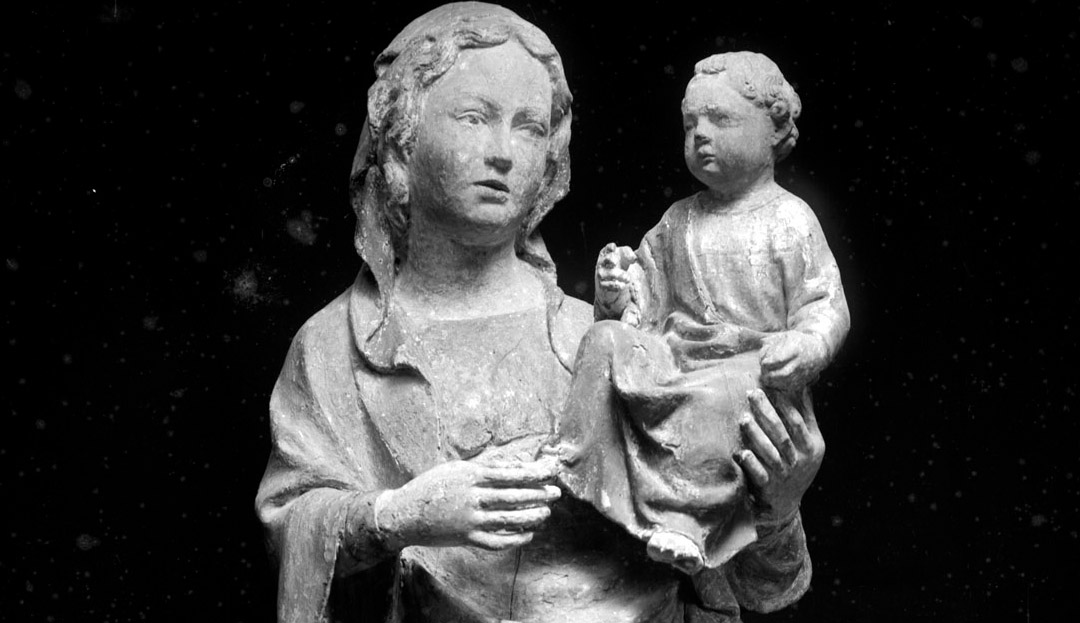
Madonna con il Bambino di artista toscano del primo Quattrocento

Madonna con il Bambino di artista toscano del primo Quattrocento
An extraordinary work from Vittorio Cini’s collection returns to Monselice Castle. It is a Madonna and Child, carved and painted in wood, the work of a Tuscan master from the early 15th century, which was stolen on 10 March 1977 and, thanks to the investigations of the Carabinieri Cultural Heritage Protection Unit in Venice, was fortunately recovered and returned to the Giorgio Cini Foundation, which owned the Castle at the time of the theft.
Thanks to collaboration agreements between the Veneto Region, the current owner of Monselice Castle, Veneto Edifici Monumentali srl, the complex’s managing body, and the Giorgio Cini Foundation, the precious sculpture recovered by the Carabinieri is now returning to the splendid location chosen for it by Vittorio Cini.
The return of the sculpture of the Madonna and Child, dating from the second decade of the 15th century, once again offers the opportunity to admire part of Vittorio Cini’s collection in the place for which it was intended, together with the precious furnishings that were an essential part of it.
To mark the occasion, a presentation has been organised in the Businaro Hall of the Castle, where the work will be on display until spring 2027.

SALUTI
–
Aldo Rozzi Marin
Amministratore unico, Veneto Edifici Monumentali s.r.l.
–
Filippo Giacinti
Assessore al Bilancio – Patrimonio – Affari Legali – Personale – Attuazione Programma e Agenda Digitale della Regione Veneto
–
Valeria Mantovan
Assessore all’Istruzione – Formazione – Competenze e Cultura della Regione Veneto
–
Stefano Peraro
Sindaco della Città di Monselice
–
Annalisa Nacchi
Direzione Gestione del Patrimonio, U.O. Complessi Monumentali e Progetti di Valorizzazione
–
Renata Codello
Segretario Generale, Fondazione Giorgio Cini
–
INTRODUCE
–
Luca Massimo Barbero
Direttore dell’Istituto di Storia dell’Arte,
Fondazione Giorgio Cini
–
INTERVENGONO
–
Federica Siddi
Storica dell’arte
–
Laura Cavazzini
Università di Trento
The work was purchased towards the end of 1941 by the Roman antiquarian Alfredo Barsanti and most likely placed in the so-called Sala dell’angelo (Hall of the Angel) of the Romanesque House – the oldest part of the complex – as stated in the deed of donation of Monselice Castle to the Giorgio Cini Foundation, signed on 23 February 1972. A few years later, during the night of 10 March 1977, unknown individuals broke into the property and stole several artefacts, including this Madonna and Child. It was lost for a long time, until Federica Siddi, during research on wooden sculpture in Lombardy conducted in 2015, revealed its location at the Museum of San Lorenzo di Zogno, in the province of Bergamo. The joint action of the Carabinieri Cultural Heritage Protection Unit in Venice finally made it possible to recover the work and return it to the Giorgio Cini Foundation, owner of the castle and the works housed there at the time of the theft.
This is a crucial moment, not only for the history of Vittorio Cini’s collection, which the Foundation has always sought to preserve, but also for launching new research into the rediscovered work, already cautiously attributed to the Sienese sculptor Francesco di Valdambrino, who was active between the end of the 14th century and the early decades of the following century. While it is possible to detect similarities with some of the artist’s known works, such as the Madonna and Child in the church of Sant’Andrea in Palaia, signed and dated 1403, there is also a striking resemblance to another wooden sculpture preserved in the National Museum of Villa Guinigi in
Lucca, attributed to a Lucca sculptor working on the cathedral in the years when Valdambrino himself was staying in the city. The recovery of the Madonna Cini therefore marks a fundamental turning point in investigating the circulation of solutions and models in the Pisa-Lucca area: a direct comparison with the Lucca Madonna may in fact clarify the nature of their relationship, whether one is the model for the other or whether both derive from the same prototype, thus helping to outline more precisely the complex context of artistic production between the end of the 14th and the beginning of the 15th century.
Madonna con il Bambino di artista toscano del primo Quattrocento

