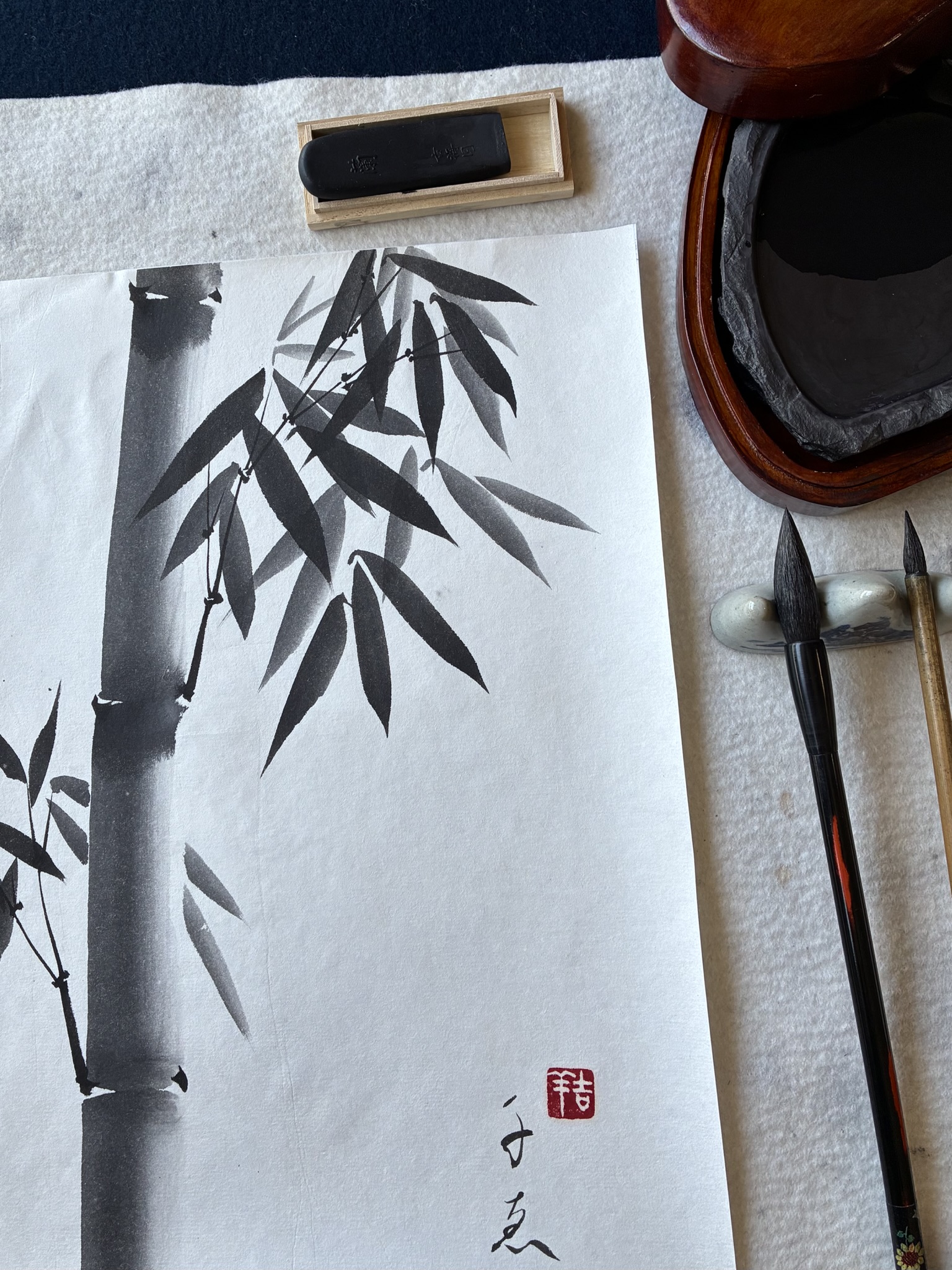
Workshop on suiboku

The Centre for Comparative Studies of Civilisations and Spiritualities is pleased to announce a new workshop dedicated to the Japanese art of suiboku.
The event will offer an immersive experience in the traditional Japanese art of ink painting, a practice that combines gesture, contemplation, and aesthetic sensitivity. Participants will be guided in the preparation of the materials. This initial, slow and ritualistic moment promotes a state of concentration and inner calm. Subsequently, the fundamental strokes will be explored through exercises that reproduce fine lines, broad brushstrokes, and nuances created with variations in pressure and quantity of water. The emphasis will be on simplicity and spontaneity: a single gesture, if authentic, can encapsulate an entire landscape. The workshop will also introduce typical suiboku subjects, such as bamboo, orchids, plum blossoms, and mist-shrouded mountains, encouraging each participant to find their own personal interpretation.
Workshop schedule and booking
The students will be guided through this experience by the Artist Chie Iwakiri, who will lead three workshop days (4-5-6 March) for a maximum of 15 students per day, from approximately 15:00 to 17:00.
Participants may register for only one day. On the first day only, March 4 from 14:00 to 15:00, an introductory lecture in Italian will be held by Prof. Silvia Vesco (Department of Asian and Mediterranean African Studies, Ca’ Foscari University, Venice) for all registered participants.
programmE
4 March

14:00-15:00
Silvia Vesco
introductory lecture in Italian
15:00-17:00
Teacher Chie Iwakiri
Workshop in English
5 March
15:00-17:00
Maestra Chie Iwakiri
Workshop in English
6 March
15:00-17:00
Maestra Chie Iwakiri
Workshop in English
The workshop is free of charge, but registration is required.
To register, please send an email to [email protected] indicating your chosen day and the following details: first name, last name, telephone number, and affiliation (if you are a student).
Please note: Registration will only be effective upon receipt of a confirmation email from the secretariat.
As there are 15 places available per day, please note the following:
- Registration requests with missing information cannot be accepted.
- You can only register for one day.
- The email must be for a single participant; multiple registrations will not be accepted.
In case of cancellation, please notify the secretariat as soon as possible to give another person the opportunity to participate.
Please also notify us of any delays.
Short Bio of Chie Iwakiri
Artist / Master Instructor of the International Sumi-e Association
Born in Yokohama, I graduated from the Graphic Design department of Tama Art University in 1985. From 1989 to 1991, I stayed in Venice, where I practiced lithography at the Scuola Internazionale di Grafica and held a solo exhibition.
Since 2000, my work has been selected for exhibitions such as the Kochi International Triennial Exhibition of Prints. Later, I focused my practice on Suibokuga. Currently, I hold a Master Instructor qualification from the International Sumi-e Association and have received awards including the China Art News Award and the Association’s Chairman’s Award.
March 2025: Conducted a workshop at Ca’ Foscari University of Venice and held a Sumi-e exhibition at SG Gallery.
Alongside my own creative work, I teach classes, lead workshops, and give private lessons. I continue to explore the history and the future of ink wash painting, valuing the discipline required for its irreversible process.
Short bio of Silvia Vesco
Silvia Vesco is a professor of Japanese art history at the Department of Asian and Mediterranean African Studies at Ca’ Foscari University in Venice. After completing a Master’s degree in East Asian Art and Archaeology at the University of London and a PhD (joint degree Italy-Japan), she lived and studied in Japan for many years. She has organized several international conferences and curated important exhibitions of Japanese art in prestigious venues in Italy and Japan.
Her scientific interests focus on ukiyo-e prints and paintings (images of the ‘floating world’), with particular reference to the work of Katsushika Hokusai (1760-1849), Japonism and textiles, as well as Japanese art collections in public and private collections in Italy. His latest publications include contributions dedicated to prints by Andō Hiroshige (1797-1858) and Utagawa Kunisada (1786-1865) and the refined iconography of Genji monogatari (The Tale of the Shining Prince), as well as Haori: Gli abiti maschili del primo Novecento narrano il Giappone, as well as the first translation into a Western language of two manuals on painting by Katsushika Hokusai. In addition, Einaudi has published the first of two volumes on the history of Japanese art from prehistory to the modern era. The second volume on the history of Japanese art and its developments up to the contemporary era is currently being published.
ABSTRACT Introductory lecture
Shodō and Suiboku as paths to self-cultivation
Shodō (calligraphy) and suiboku (ink painting) are not simply artistic techniques, but true “ways” (dō) aimed at spiritual perfection and self-knowledge. Through historical and philosophical analysis, some fundamental points emerge, such as:
The unity between Body and Spirit, since the practice requires absolute consistency between inner energy and concrete action. The brush is not merely a tool, but an extension of the body that must act with the spontaneity of the “heart-mind” (kokoro).
Learning takes place through a long apprenticeship based on repetition and imitation of models (kata). This apparent lack of individual freedom is, in reality, a prerequisite for internalizing the technique and achieving “living” creativity.
To produce authentic beauty, the practitioner must act without artificial intent, reaching a state of “empty mind” (mushin) that allows identification with the whole and, ultimately, even enlightenment.
Calligraphy and ink painting share concepts such as wabi, sabi, and yūgen with Japanese aesthetics, valuing sobriety, the charm of time, and ineffable depth.
These disciplines represent an ethical and aesthetic path where the ultimate goal is not to “possess a skill” but to “be” by overcoming individual selfishness.

