Istituto di Storia dell’Arte Archives - Fondazione Giorgio Cini

A Guest at the Palace | Minerva Infuses the Soul into the Human Figure Modeled in Clay by Prometheus by Pompeo Batoni

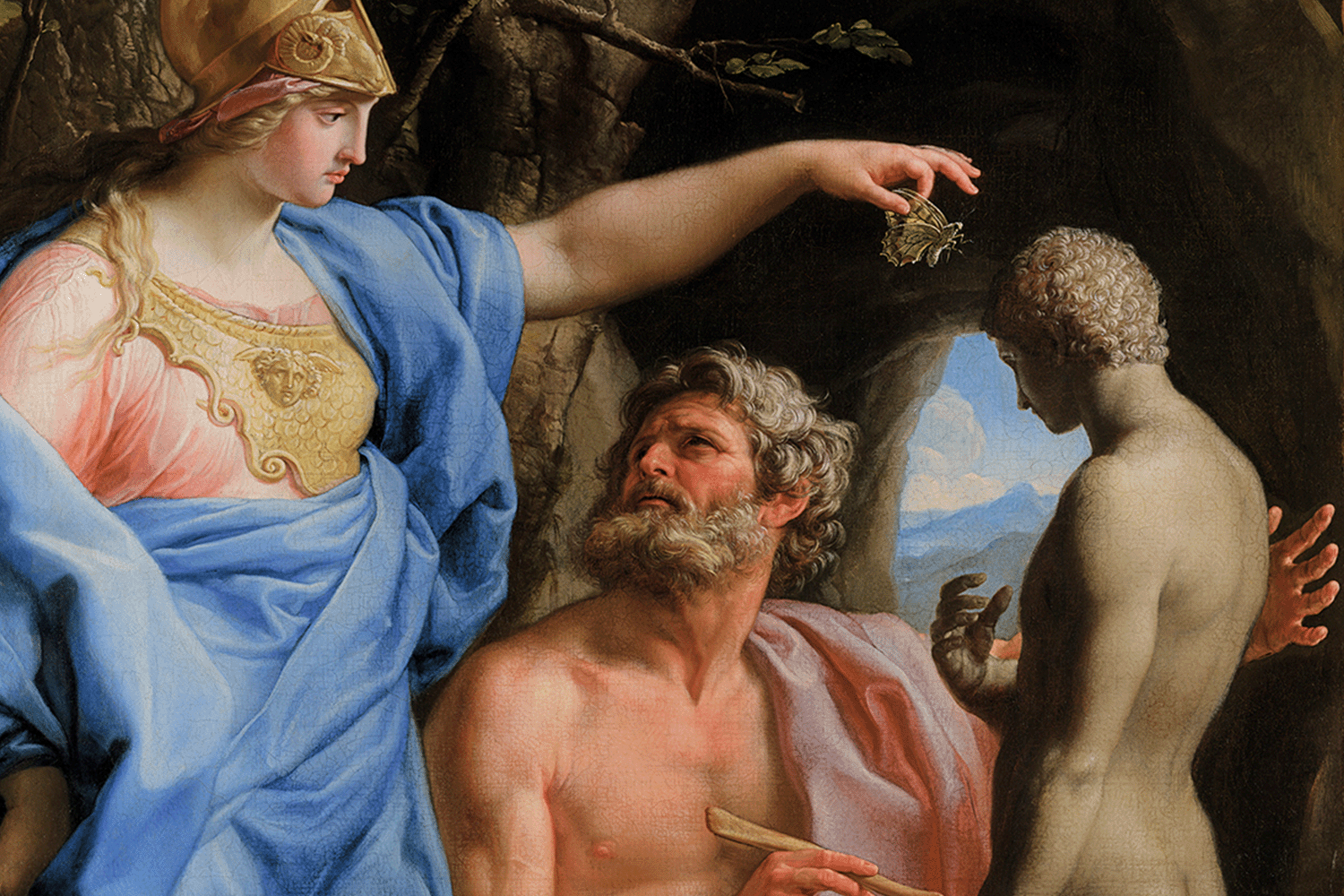
On the occasion of the opening season of the Galleria di Palazzo Cini at San Vio, the new “guest at the Palace” is the picture Minerva Infuses the Soul into the Human Figure Modeled in Clay by Prometheus by Pompeo Girolamo Batoni (Lucca, 1708 – Rome, 1787), dating from between 1740 and 1743. The work, which explores the theme of the genesis of life through a subject never before treated in painting, was conceived starting from the classical iconography of a group of Roman sarcophagi depicting the myth of Prometheus. It is the work of one of the most celebrated artists of eighteenth-century Italy, of whom only rare examples exist in Venice, and represents an important testament to Batoni’s passion for mythological subjects, as well as a remarkable achievement of his early maturity.

The exhibition, organized by the Giorgio Cini Foundation’s Institute of Art History, the Cassa di Risparmio di Lucca Foundation, and the Lucca Center for the Arts Foundation, also serves as an opportunity to announce the creation of the future museum space at the Lucca Center for the Arts —a collaboration between the Fondazione Cassa di Risparmio di Lucca and the Fondazione Centro Studi sull’Arte Licia e Carlo Ludovico Ragghianti—where Batoni’s painting will be on display starting in 2029.

Minerva Infuses the Soul into the Human Figure Modeled in Clay by Prometheus
plus

The magnificent painting by Pompeo Batoni, one of the most celebrated artists of the Italian Settecento, stands as a significant testament to his fascination with mythological subjects, as well as a remarkable achievement of his early maturity. Addressing the theme of the genesis of life through a subject never before treated in painting, the work draws upon the classical iconography of a group of Roman sarcophagi depicting the myth of Prometheus.

The subject of the picture derives from Metamorphoses (I, 76–88) and, together with the canvas Atalanta Mourning the Death of Meleager, now in the same foundation, was executed for the Marquis Lodovico Sardini during the period in which the artist divided his time between Rome and his native city, to which he remained profoundly attached throughout his life.

The Titan Prometheus is depicted in the act of bringing to completion his greatest creation: a young man modelled from clay, embodying the classical ideal of beauty and in all likelihood inspired by the celebrated Hermes Pio-Clementino, then known as the Antinous Belvedere. Beside him, the goddess Minerva—derived from the Minerva Giustiniani and softened according to the canon of grace—advances to breathe life into the figure, offering him a butterfly, the traditional emblem of the soul.

The canvas bears witness to the extraordinary level of refinement achieved by Batoni during the first half of the 1740s. Hailed as a “new Raphael,” he worked for some of the most eminent figures of his age, from Popes Benedict XIV, Clement XIII and Pius VI to Maria Theresa, Frederick II of Prussia and Catherine II. He was especially renowned for his religious, mythological and historical compositions, as well as for his portraits, many of which were commissioned by wealthy travellers passing through Rome on the Grand Tour.

Opening hours and admission
plus

It is open every day (except Wednesdays) from 11:00 a.m. to 7:00 p.m.

All editions
plus

May 24 – July 21, 2014

Portrait of a Young Man with a Lute by Agnolo Bronzino


September 5 – November 2, 2014

Adoration of the Shepherds by Lorenzo Lotto 


June 17 – September 28, 2015

The Madonna of Pontassieve by Beato Angelico


September 19 – November 15, 2015

Capriccio with a Small Square by Francesco Guardi  


April 8 – June 6, 2016

Saint Mark by Andrea Mantegna


May 28 – November 1, 2021

Saint George and the Dragon by Paolo Uccello


July 15 – October 15, 2023

Warsaw, Church of the Holy Cross by Bernardo Bellotto


May 11 – July 16, 2023

Cleopatra by Artemisia Gentileschi


May 14 – September 8, 2025

The Crucified Christ by Antoon van Dyck


June 18  — September 27, 2026

Minerva Infuses the Soul into the Human Figure Modeled in Clay by Prometheus
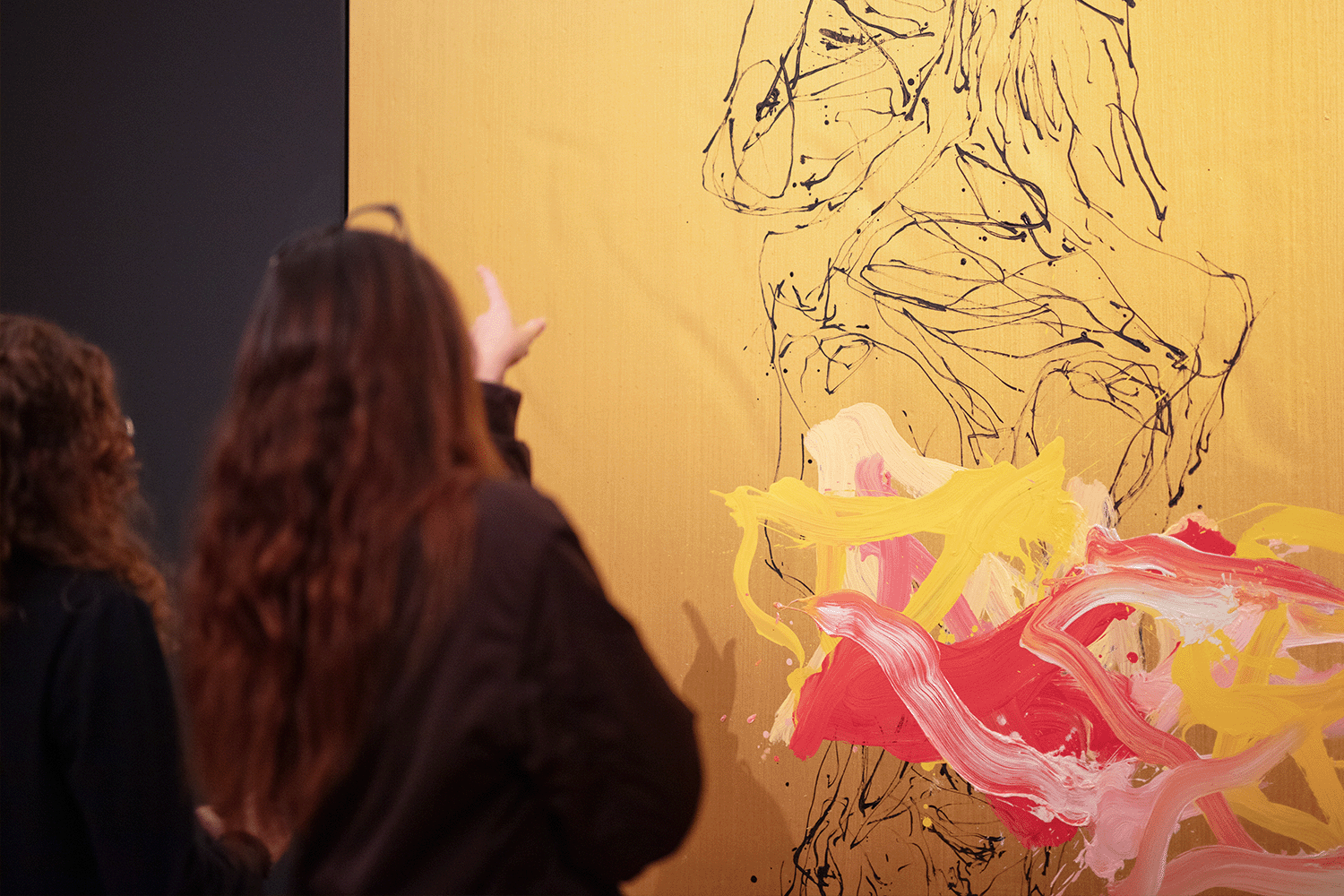
Georg Baselitz. Eroi d’Oro

The exhibition Georg Baselitz. Eroi d’Oro, curated by Luca Massimo Barbero, director of the Institute of Art History of the Fondazione Giorgio Cini, features the German artist’s most recent series of large-scale paintings. The golden planes that form the grounds of the works on view, offer no illusion of depth; they creates a flatness reminiscent of medieval icons or the gilded backgrounds of the works of Northern Renaissance painter Stefan Lochner. Georg Baselitz’s painted bodies, executed in sharp lines, lie bare across these grounds as if floating on their surfaces, rendered through an approach that inherits from line drawing. They include larger-thanlife self-portraits, as well as numerous depictions of the artist’s wife, Elke, his lifelong companion and recurring model.

Applied with diluted black paint that resembles ink, the spectral portraits hark back to Hokusai’s portraits and Japanese calligraphy. Several of the canvases incorporate thick, viscous brushstrokes that gather on the figures, associating multiple colours to give a marbled, variegated effect.

While gold has always held diverse connotations and functions within his practice, never before have Baselitz’s paintings borne such a direct resemblance to icon painting.

The exhibition is organised in partnership with Thaddaeus Ropac Gallery.

[accordion][/accordion]
[accordion_entry title=”Opening hours and admission“]
It is open every day (except Wednesdays) from 11:00 a.m. to 7:00 p.m.

[/accordion_entry]
[accordion][/accordion]

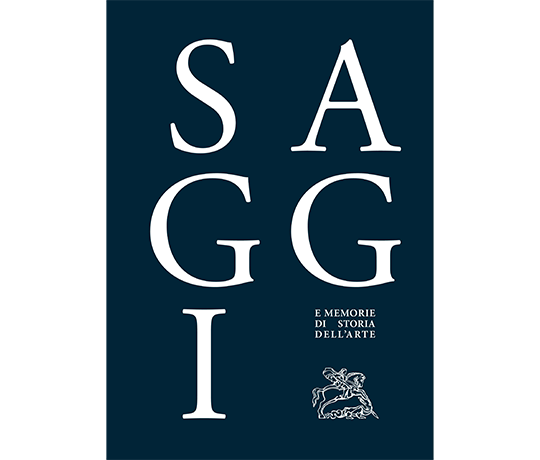
«Saggi e Memorie di storia dell’arte» 48

  • Silvia Urbini, Amico Aspertini e il Nuovo Mondo
  • Francesca Girelli, Il baldacchino marmoreo per la cappella di san Giovanni Battista nella Cattedrale di Genova e l’allestimento delle reliquie del Precursore all’inizio del XVI secolo
  • Olga Piccolo, La ‘Leda al bagno’ della Scuola di Correggio già Salviati, Colonna e Rospigliosi: un interessante episodio di collezionismo nella Roma del XVI–XX secolo 
  • Fiorenzo Fisogni, Il Terzo Libro del Giardino della Pittura di Francesco Paglia. Una guida per l’Italia del Seicento
  • Riccardo Naldi, Girolamo Seripando, Annibale Caccavello e il coro ligneo della cattedrale di Salerno
  • Vincenzo Mancini, Francesco Ruschi pittore romano?
  • Valeria Sedleryonok, La formazione della collezione delle Gallerie dell’Accademia di Venezia dal 1807 al 1817 come costruzione di una nuova immagine della scuola veneta
  • Carolina Trupiano Kowalczyck, Jules-Robert Auguste, Eugène Delacroix, Louis La Caze e il barone Schwiter nella Parigi delle avanguardie. La nascita del gusto orientale e il revival del rococò francese
  • Fausta Piccoli, Una tela di Cosroe Dusi per Francesco Gualdo
  • Alice Cutullè, In memoria di Yole Biaggini Moschini: ritratti in prosa, pittura e scultura
    • Zavatta, “Siamo di fronte a un’offensiva organizzata in grande” Antonio Morassi, Roberto Longhi e le polemiche intorno alla Mostra dei Guardi del 1965
    • Greco, L’immagine della scultura di Hans Arp in Italia attraverso le fotografie riprodotte nelle pubblicazioni nazionali (1947-1966)

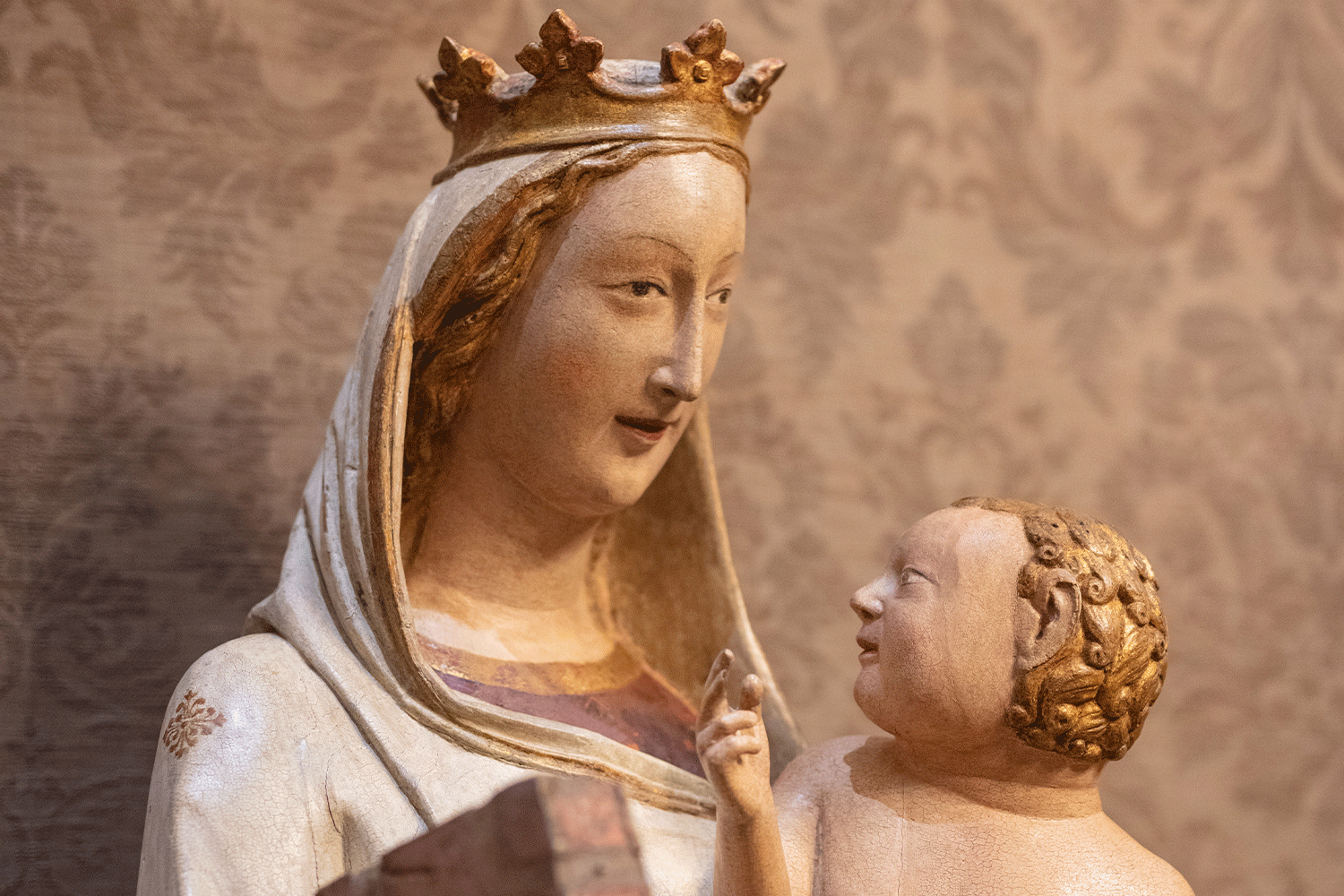
    Madonna and Child

    Madonna and Child is a wooden sculpture measuring 176 cm in height, dating to the second half of the 14 th century. The Madonna is shown wearing a red tunic embellished with embroidery, with golden borders; she is wrapped in a veil, white on the inside and blue on the outside, with gilded edges executed with gold leaf applied with the “a guazzo” technique. The Virgin has noble and elegant features and wears a crown on her head; she holds the Child in her arms, who in turn caresses a dove. With her other hand, the mother supports a voluminous open book, customary iconographic symbol of the future already written in the sacred text.
    The restoration, completed towards the end of 2025, was conducted thanks to Save Venice Inc. and Christopher Todd Page, under the supervision of the Soprintendenza Archeologia Belle Arti e Paesaggio per il Comune di Venezia e Laguna (Office for the Protection of Architectural, Natural, Historic, Artistic and Ethno-Anthropological Heritages in Venice and Its Lagoon).

    THE HISTORY

    Purchased in 1960 by Vittorio Cini from the Florentine antiquarian Giovanni Salocchi, the statue has always been kept in the Gallery of Palazzo Cini at San Vio. A few years later, the Madonna was attributed to 14 th -century Florentine craftsmen, later identified with the circle of sculptors Alberto Arnoldi and Giovanni di Ambrogio. Subsequently, the attribution shifted to an Abruzzese author.

    THE RESTORATION

    The analyses carried out during the restoration are important, as they reconstructed the conservation history of the sculpture: the Madonna was originally dressed in a white mantle and tunic, decorated with gilded pastiglia. The statue was found compromised in numerous areas and bore traces of invasive interventions that had altered the chromatic scheme.
    Therefore, the restoration required disinfestation, consolidation of the wooden elements, cleaning of the surfaces, retouching and final varnishing.

    Maestro Abruzzese (?), Madonna con il Bambino, Scultura in legno policromo, Seconda metà del XIV secolo, Palazzo Cini. La Galleria.

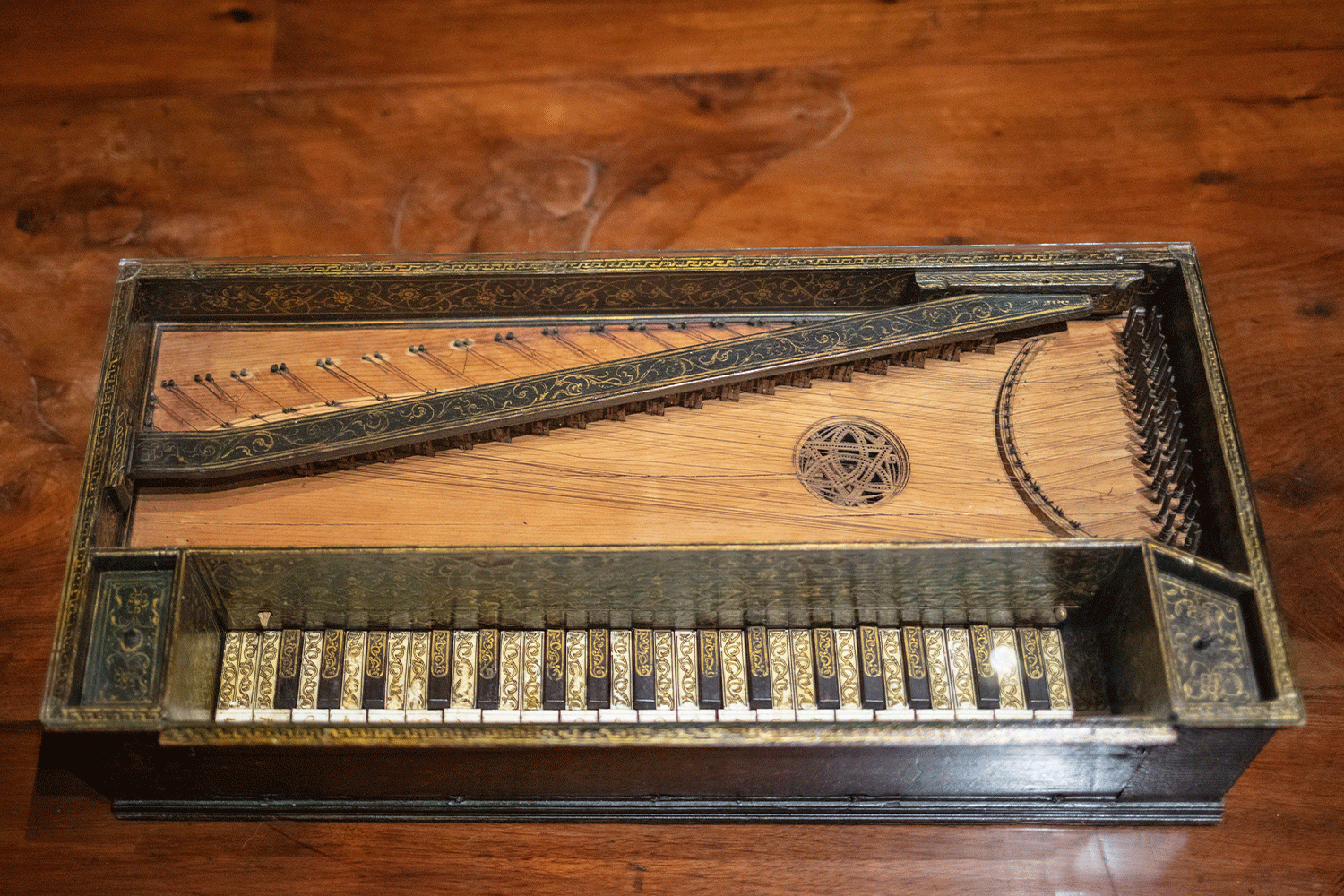
      Venetian Virginal (Harpsichord)

      Dating to the late 16th century, keyboard musical instruments in the shape of a small spinet were very popular in the late Renaissance period and especially appreciated for their pleasant and harmonious sound.

      The artefact presents a rich decorative scheme on both the interior and exterior, on a lacquered base coat that runs across the entire wooden case: with cartouche motifs and swirl designs traced in gold on a black ground. The white keys, made of bone and ebony, are also adorned with gold lettering and arabesque decorations. The stand, by contrast, is constructed from the assembly of wooden blocks; the soundboard still presents the chords, the jacks and all the useful components for the utilisation of the instrument.

      The restoration, completed at the end of 2025, was conducted thanks to the support of the Boston Chapter of Save Venice Inc., under the supervision of the Soprintendenza Archeologia Belle Arti e Paesaggio per il Comune di Venezia e Laguna (Office for the Protection of Architectural, Natural, Historic, Artistic and Ethno-Anthropological Heritages in Venice and Its Lagoon).

      THE HISTORY

      In terms of style and chronology, the artefact has been compared to another highly refined specimen, preserved at the Royal College of Music in London, signed by Giovanni Celestini in Venice in 1593, it dates to the same period as the Cini artefact.

      Purchased by Vittorio Cini in 1938 from antiquarian Antonio Carrer, the Virginal was later collocated in the Castle of Monselice’s hall of honour, as documented in the 1940 volume by Nino Barbantini dedicated to the ancient monumental complex.

      THE RESTORATION

      Preliminary analysis prior to the conservation revealed the presence of superficial deposits and overpainting of the damaged areas, which over time had been integrated in the varnish layers, obscuring gilding and iridescent lacquers. In addition to the breakage of the main lid, traces of a past infestation by wood-boring insects were identified. The restoration focused on recovering the original paint layer and its varnish, cleaning and intervening on minor fractures and abrasions. 

      Ignoto, Virginale, strumento della famiglia dei clavicembali con decorazioni in oro, fine XVI secolo, Misure: cm 25 x 120 x 52, Palazzo Cini. La Galleria.

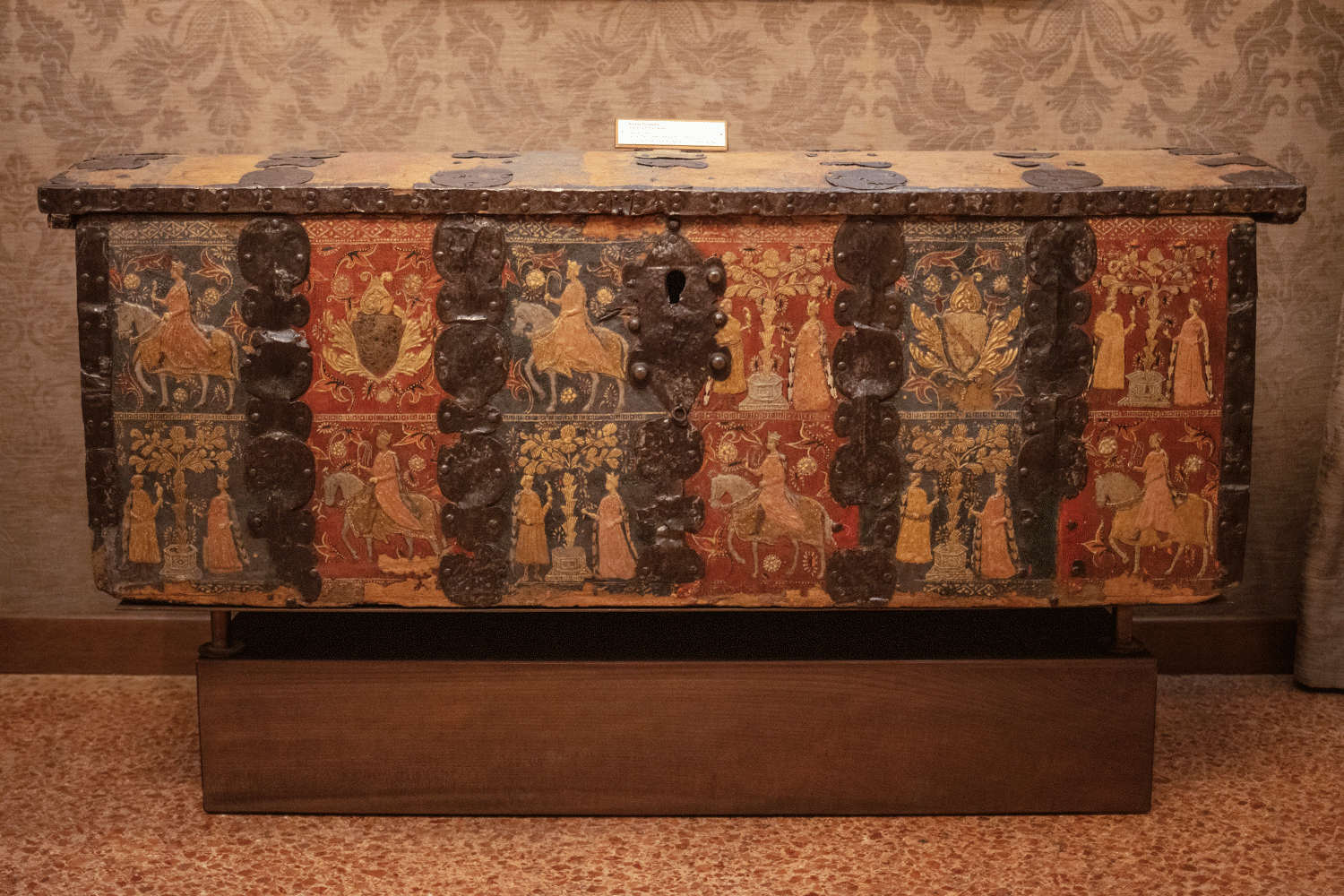
        Marriage Chest

        The piece, of Florentine manufacture dating to the second quarter of the 14 th century, is made of poplar wood and measures 52 x 144 x 58,5 cm.
        The lid is slightly domed and reinforced by flatten iron bands which divide the front into five panels. Each panel represents two superimposed scenes executed in slight relief, alternating against grounds of red and blue. The decorated scenes reprise themes codified in courtly tradition and very common in nuptial iconography. One can observe the young man and the lady on the sides of the Fontana d’Amore (Fountain of Love) and then the crowned knight on horseback, now holding a whip, now holding a sceptre.
        On either side of the central lock, two shields with the family coats of arms: one unfortunately illegible, the other identifiable as the crest of the Del Riccio family, confirming the Florentine origin of the piece. The short sides of the chest are embellished with floral motifs, again in slight relief and on red backgrounds alternating with blue ones. On the lid, traces of the original pastiglia decoration are still visible.
        The restoration, completed in 2025, was conducted thanks to Save Venice Inc. and Christopher Todd Page, under the supervision of the Soprintendenza Archeologia Belle Arti e Paesaggio per il Comune di Venezia e Laguna (Office for the Protection of Architectural, Natural, Historic, Artistic and Ethno-Anthropological Heritages in Venice and Its Lagoon).

        THE HISTORY

        The chest entered the Cini Collection from the collection of Anna Maria di Bosco by 1940 and was then placed in the Castle of Monselice. Subsequently, it was kept in the Gallery of Palazzo Cini at San Vio, in the Sala dei Primitivi (Room of the Primitives).

        THE RESTORATION

        During the analysis, some damaged areas were identified, specifically on the lid and the base, due to a significant infestation of wood-boring insects. In addition to the presence of large, deteriorated metal nails, and the subsequent loss of wooden material, further issues concerning the painting layer and various more losses concealed by coarse fills and by pictorial retouchings that have since been altered.
        After phases of disinfestation, repair and consolidation of the compromised and degraded wooden and metal elements, there followed a very complex phase of surface-cleaning which removed all of the maintenance varnishes and the altered retouchings, without affecting the early-20 th -century reconstruction since it had been executed to an excellent standard; then, the intervention of retouching and chromatic calibration and the final
        varnishing. Operations were preceded by appropriate stratigraphic analysis, aimed at determining the composition of the pigments, binders and the reconstructions.

        Manifattura fiorentina, Cassone nuziale (Amanti alla fontana d’Amore e cavalieri), Ultimo quarto del XIV secolo, Palazzo Cini. La Galleria.

        «Arte Veneta» 81

        CONTENTS

        • Beatrice Alai, Un frammento inedito dell’evangelistario marciano al Detroit Institute of Arts
        • Dario De Cristofaro, Per una revisione del corpus di Stefano da Ferrara pittore trecentesco
        • Mattia Vinco, Albert Figdor, Theodor von Frimmel e il Cristo benedicente della pala Avanzi di Francesco Morone
        • Michele Guida Conte, Il monumento funebre di Girolamo Bencucci, vescovo di Vaison e nunzio di Clemente VII
        • William L. Barcham, Gianluca Poldi, Una Favola di Minerva e Diana, una nuova proposta per il giovane Giambattista Tiepolo
        • Denis Ton, Le “mezze figure di donne a capriccio” di Giambattista Tiepolo per Elisabetta Petrovna: una nuova proposta
        • Giuseppe Beretti, Fantasie stupefacenti e ingegnose. Giovanni Battista Piranesi, stucchi e intagli veneziani rococò

        NOTICES

        • Federica Giamattei, Una proposta per Jacopo Moranzone: la Madonna della Misericordia del Museo Correr
        • Francesco Ceretti, I “portelli” di Callisto Piazza in San Domenico a Brescia: cronaca di un’odissea
        • Giulia Zaccariotto, Agostino Landi ritratto da Danese Cattaneo e Tiziano Vecellio (sull’identità del Gentiluomo con libro di Boston)
        • Luca Trevisan, Il volto di Girolamo Albanese in un ritratto delle collezioni di Palazzo Chiericati
        • Francesca Baldassari, Per Antonio Carneo. Aggiunte
        • Diana Pollini, Un Ratto di Elena su rame, dono di Paolo Farinati a Gian Giacomo Giusti
        • Martina Leone, Stefano L’Occaso, Note veneziane nella chiesa del Gesù all’Argentina: Antonio Zanchi a Roma

        ARCHIVE PAPERS

        • Anne Markham Schulz, Venetian and Paduan Tombs by Andriolo de’ Santi
        • Riccardo Tonin, Francesco Bissolo a San Biagio di Venezia: circa vent’anni di vita
        • Luca Bernardini, La Compagnia delle Quarantore a Venezia: orazione mentale e immagini
        • Anna Bernante, Nuovi documenti per Giovanni Zamberti, precettore di prospettiva
        • Alberto Lai, “Fatige grandissime con pochissima ricompenssa al mio solito”: una lettera inedita di Louis Dorigny, il suo primo soggiorno trentino e gli affreschi del duomo di Trento (1730-1731)

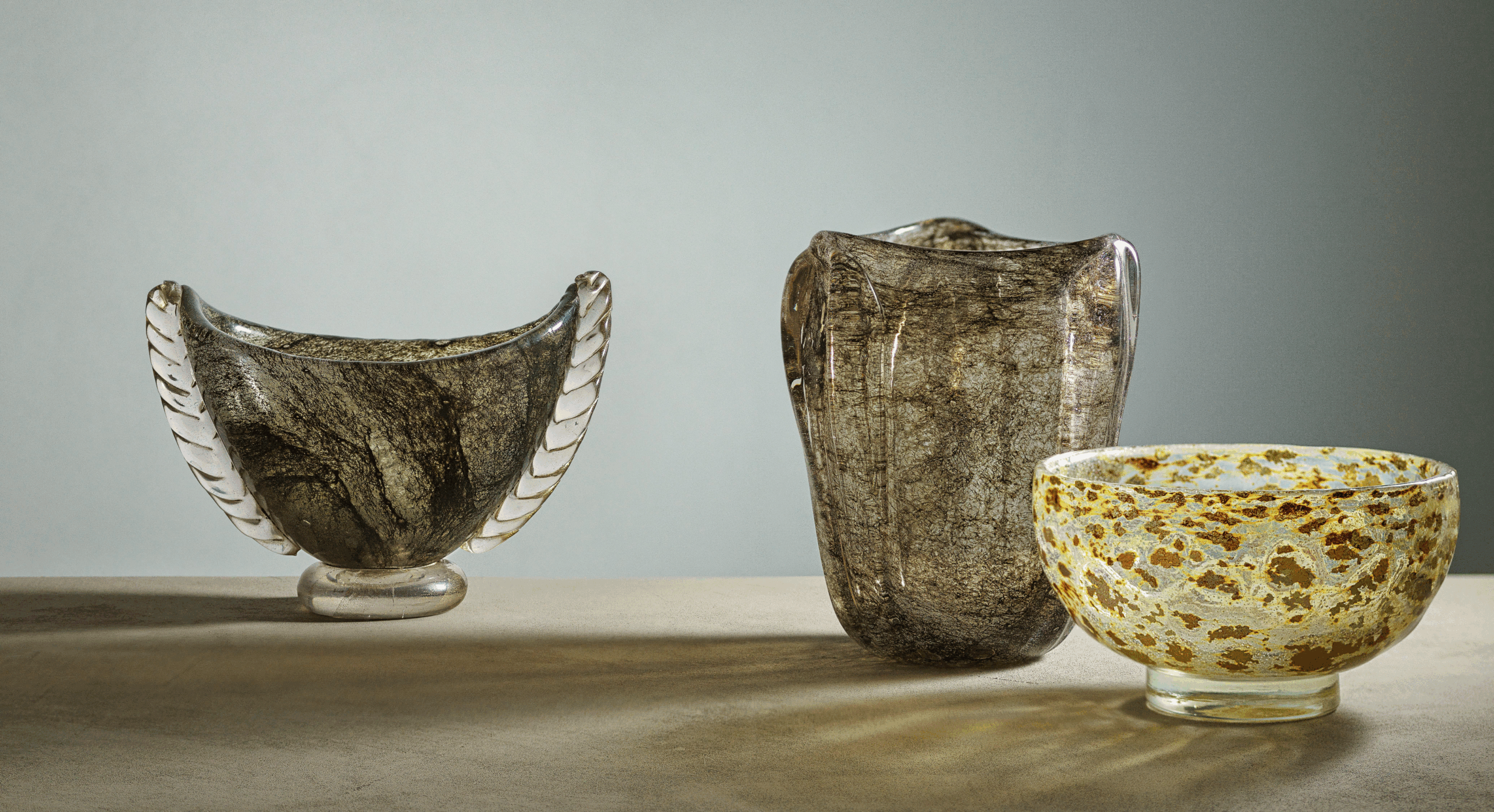
        Glass and Decorative Arts at the Venice Biennale

        In line with the second exhibition chapter, situated at LE STANZE DEL VETRO on the evolution of Murano’s activity and production at the Venice Biennale in the decade 1932-1942, the Glass Study Center is organizing its usual annual conference. It focus on themes and dynamics during the period in question, thanks in part to the international openness that the lagoon events allowed for experimental progress in glass art in that juncture of time.

        In fact, 1932 represented a sort of significant watershed, considering that from that year onwards, for the first time, the International Institution decided to dedicate an autonomous section to Murano glass, giving it a designated space and considerable visibility.

        The protagonist of this conceptual and programmatic shift was the then Secretary General Antonio Maraini, who involved architect Brenno Del Giudice in designing and building the Venice Pavilion. An architectural idea that was as coherent as it was functional in terms of promoting the decorative arts, thus also expanding the gardens of the Biennale itself.

        This was a forward-looking operation that immediately launched a period of remarkable creativity and experimental momentum, which was unfortunately brought to an abrupt halt in 1942 by the Second World War.

        It is precisely thanks to this extraordinary artistic fervor of national and international scope, aided by the synergies between prestigious glassworks and artists and designers of great depth—such as Ercole Barovier, Pietro Chiesa, Flavio Poli, Carlo Scarpa, and Vittorio Zecchin—that experts in glass and decorative arts will explore the context and taste of the design evolution. It was developed both in contemporary, in France, and through other displaying venues, including the Triennale di Milano.

        A continuously growing ferment that will mark a decisive leap in quality in the glass art sector, above all thanks to the numerous opportunities for exchange and the expansion of the global collectors’ market, which is, now and then, always open to revisited technical solutions and innovative methods.

        The conference will be preceded on Wednesday 5 November by the presentation of the Quaderni del Vetro series, which in this second edition pays tribute to international artists Cristiano Bianchin, Silvano Rubino and Giorgio Vigna. On this occasion, their respective digital archives will be published on the Fondazione Giorgio Cini website, putting approximately 3,500 items online, including photographs, drawings and sketches, accompanied by the relevant catalogue entries.

        PROGRAMME

        [accordion][/accordion]
        [accordion_entry title=”5 novembre| h 12:00″]

        Presentazione collana Quaderni del Vetro
        [/accordion_entry]
        [accordion][/accordion]

        [accordion][/accordion]
        [accordion_entry title=”6 novembre  | h. 9.30 – 13.00″]

        Saluti istituzionali
        Luca Massimo Barbero
        Direttore dell’Istituto di Storia dell’Arte, Fondazione Giorgio Cini

        Paola Cordera
        Verre-en-valise: un repertorio per la modernità


        Debora Rossi e Lia Durante

        Un racconto, attraverso i documenti dell’ASAC, sulla presenza delle arti decorative alla Biennale


        Giovanni Bianchi

        Il mosaico a Venezia nella prima metà del Novecento, tra produzione e promozione

        [/accordion_entry]
        [accordion][/accordion]

        [accordion][/accordion]
        [accordion_entry title=”6 novembre | h. 14.30 – 16.30″]


        Carla Sonego

        Ricerche e sperimentazioni alla Biennale (1932-1942): Carlo Scarpa ed Ercole Barovier


        Rosa Chiesa

        Il vetro e Milano


        Jean-Luc Olivié

        What happened to glass in France between 1932 and 1942?


        Lucia Mannini

        Dai vetri alle lacche: Pietro Chiesa e le presenze straniere nel Padiglione Venezia alle Biennali 1932-1936

        [/accordion_entry]
        [accordion][/accordion]


        Casanova and Venice

        On the occasion of the 300th anniversary of the birth of Giacomo Casanova, an emblematic figure of 18th-century Europe, the Fondazione Giorgio Cini is dedicating a major exhibition and cultural project to the celebrated Venetian. The first chapter of the double exhibition opens at Palazzo Cini in San Vio, from September 27, 2025 to March 2, 2026.

        Curated by the Institute of Art History, with the participation of the Institute for Theater and Opera, the exhibition traces the multifaceted figure of Casanova – scholar, memoirist, philosopher, alchemist, traveler, and diplomat – throughout the restless century of the 18th century that ended with the fall of the Serenissima.

        Through nearly one hundred works including paintings, engravings, books, objets d’art and documents from the Foundation’s collections and prestigious Italian and European institutions, the exhibition recounts the refined, cultured and contradictory world of the Venetian eighteenth century – Casanova’s century.

        The exhibition is part of a wider cultural program involving all the Fondazione Giorgio Cini institutions, with conferences, concerts and seminars dedicated to the link between Casanova, Venice and Europe. These are also the two main themes of the double exhibition, articulated in two venues:

        Casanova and Venice at Palazzo Cini in San Vio (September 27, 2025 – March 2, 2026) with a focus on Venice, the birthplace and the first stage of Casanova’s life.

        Casanova and Europe. An Opera in Multiple Acts on the Island of San Giorgio Maggiore (Oct. 17, 2025 – March 2, 2026): a look at Europe and the network of travels, relationships and adventures that made Casanova an ante litteram European figure. The exhibition Casanova and Europe. Opera in Multiple Acts is produced in collaboration for the staging with the Fondazione Teatro La Fenice.

        [accordion][/accordion]
        [accordion_entry title=”Opening hours and admission”]

        It is open every day (except Tuesdays) from 10:00 a.m. to 6:00 p.m. (last admission at 5:15 p.m.).

        SPECIAL CLOSURES

        The exhibition will be closed on 25 and 26 December 2025 and on 1 January 2026.

        FREE Admission

        On 28 September, for the European Heritage Day
        On 21 November, for the Madonna della Salute


        Guided Tour

        For groups of 20 people maximum – by reservation only by writing to [email protected]

        [/accordion_entry]
        [accordion][/accordion]

        “Il gusto dei ferraresi” nel collezionismo di Vittorio Cini

        A new event organised by the Institute of Art History at the Castle of Monselice: on Wednesday, 4 June, a conference entitled “Il gusto dei ferraresi” nel collezionismo di Vittorio Cini (“The Taste of the Ferrarese” in the Collecting of Vittorio Cini) will take place.

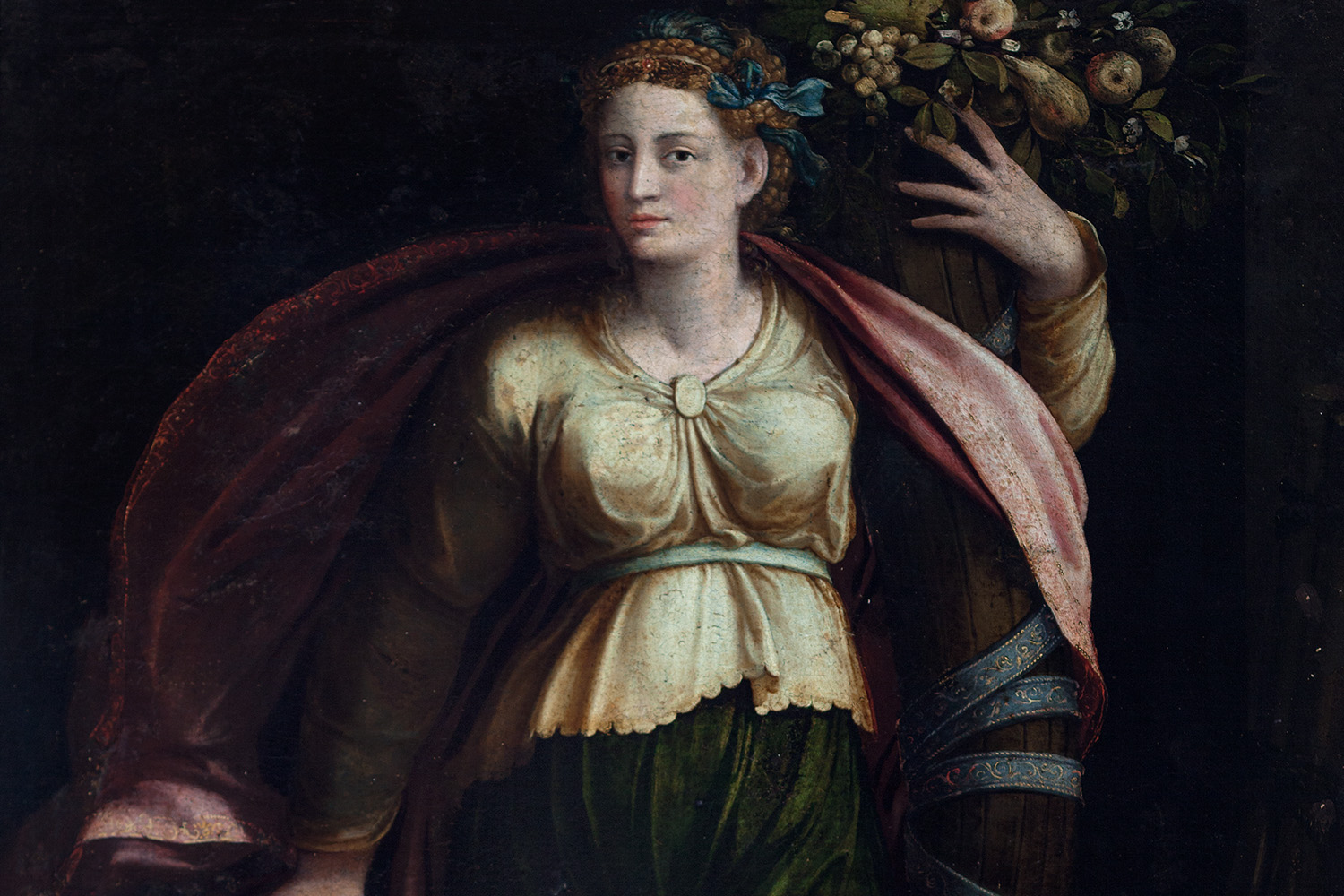
        The conference “Il gusto dei ferraresi” nel collezionismo di Vittorio Cini, curated by Alessandra Pattanaro (University of Padua), one of the leading experts on sixteenth-century Ferrarese painting, will focus on the presentation of the painting Allegoria dell’Abbondanza (Allegory of Abundance), housed at the Castle of Monselice and now attributed to Camillo Filippi. Filippi was a Ferrarese painter whose activity is well documented in the archives of the Este ducal court. The event will explore the particular significance of this work within the collection of Vittorio Cini, a passionate seeker of “Ferrarese things”, inspired by his friend, art critic Nino Barbantini, and the art historian Federico Zeri. It was under their guidance, during the 1950s and 1960s, that Count Cini assembled the remarkable core of his collection of Este painting.

        Free admission subject to availability
        RSVP [email protected]