Istituto di Storia dell’Arte Archives - Page 5 of 5 - Fondazione Giorgio Cini

A Guest at the Palace | “Saint Mark” of Andrea Mantegna

The Guest at the Palace initiative, promoted by the Art History Institute of the Fondazione Giorgio Cini, was created through collaborations with some of the most prestigious Italian and international museum institutions. Conceived to temporarily enrich the museum holdings of Galleria di Palazzo Cini, the project features the exhibition of particularly important artworks granted on extraordinary loan and hosted for several months in the historic residence of Vittorio Cini, which houses the masterpieces of his remarkable art collection.

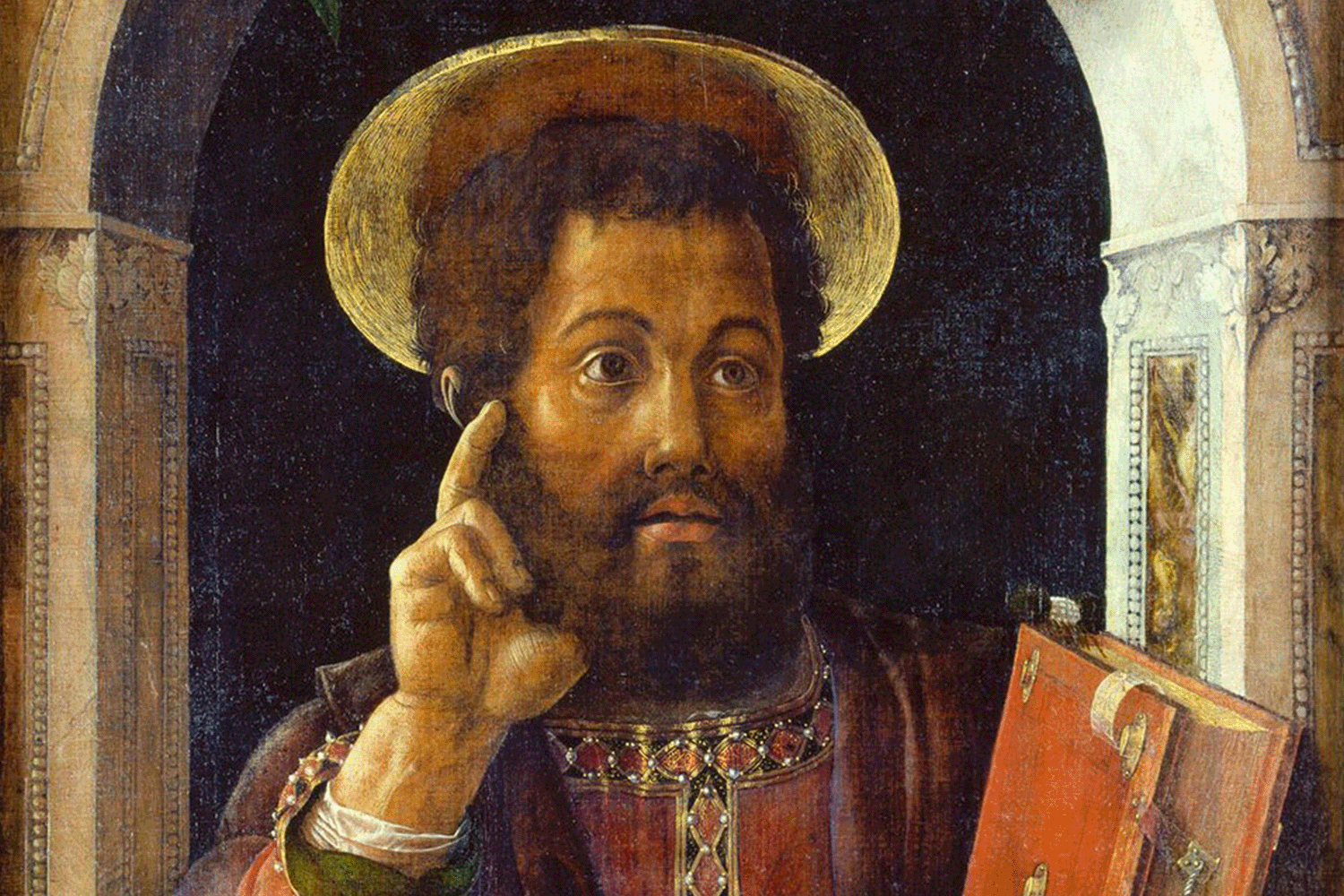
From April 8 to June 6, 2014, the Gallery’s permanent collection was enriched by an extraordinary loan: the painting of Saint Mark by Andrea Mantegna (Isola di Carturo, c. 1431 – Mantua, 1506), generously lent by the Städel Museum.

Saint Mark
plus

Saint Mark has been attributed to the very earliest phase of the young Mantegna’s activity in Padua, closely connected with the work he was carrying out in the Ovetari Chapel in the Church of the Eremitani in Padua between 1448 and 1449, in collaboration with Nicolò Pizolo. The painting represents an unsurpassed achievement of the artist’s youthful period and a cornerstone of antiquarian-inspired painting in fifteenth-century northern Italy.

The influence of his master Francesco Squarcione, evident in the rendering of details, merges with a profound commitment to the concept of solid perspective, a constant feature of Mantegna’s art. This places the Saint—absorbed in divine contemplation—within the projecting space of a marbleedicule of classical composure.

A spatial illusionism marked by noble and restrained gravity—further emphasized by the cartouche attached to the parapet bearing the artist’s signature and invocation to the Venetian patrimony of Saint Mark—makes the Frankfurt painting one of the defining masterpieces of the youth of one of the most brilliant painters of the Renaissance.

Opening hours and admission
plus

It is open every day (except Wednesdays) from 11:00 a.m. to 7:00 p.m.

All editions
plus

May 24 – July 21, 2014

Portrait of a Young Man with a Lute by Agnolo Bronzino


September 5 – November 2, 2014

Adoration of the Shepherds by Lorenzo Lotto 


June 17 – September 28, 2015

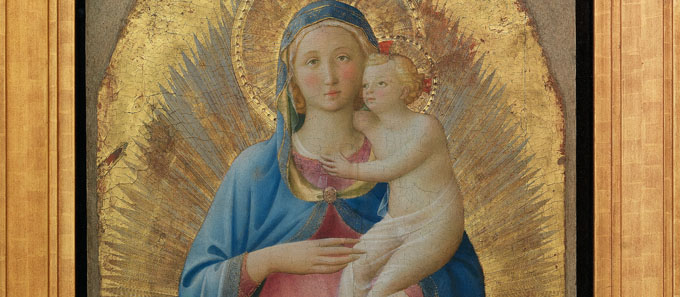
The Madonna of Pontassieve by Beato Angelico


September 19 – November 15, 2015

Capriccio with a Small Square by Francesco Guardi  


April 8 – June 6, 2016

Saint Mark by Andrea Mantegna


May 28 – November 1, 2021

Saint George and the Dragon by Paolo Uccello


July 15 – October 15, 2023

Warsaw, Church of the Holy Cross by Bernardo Bellotto


May 11 – July 16, 2023

Cleopatra by Artemisia Gentileschi


May 14 – September 8, 2025

The Crucified Christ by Antoon van Dyck


June 18  — September 27, 2026

Minerva Infuses the Soul into the Human Figure Modeled in Clay by Prometheus

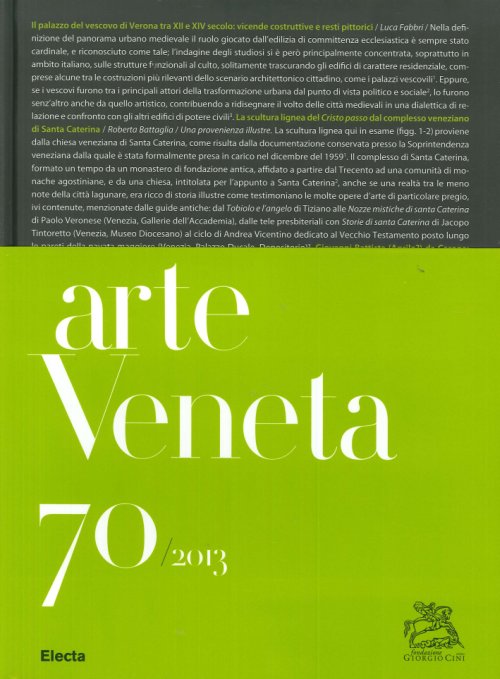
Arte Veneta 70 (2013)

Arte Veneta 70 (2013) 

Luca Fabbri, Il palazzo del vescovo di Verona tra XII e XIV secolo: vicende costruttive e resti pittorici

Roberta Battaglia, La scultura lignea del Cristo passo dal complesso veneziano di Santa Caterina

Andrea Bacchi, Giovanni Battista (Aprile?) da Carona: itinerari veneti di uno scultore lombardo del Cinquecento

Fernando Loffredo, Il monumento Euffreducci in San Francesco a Fermo. Bartolomeo Bergamasco e Pietro Paolo Stella

Stefania Mason, Dal disegno all’incisioane. Palma il Giovane e Giacomo Franco compari e collaboratori

Massimo Favilla, Ruggero Rugolo, ‘Nomen et cineres una cum vanitate sepulta’: Alvise II Mocenigo e i monumenti dogali nell’ultima età barocca a Venezia

Elena Catra e Antonella Mampieri, La ‘Pietà’ di Antonio Canova

Segnalazioni

Annalisa Pandolfo, I libri corali della chiesa dei Santi Geremia e Lucia a Venezia

Philippe Malgouyres, L’antiquité à la lumière (douteuse) des lampes de bronze

Terence de Monredon, A hitherto unpublished illumination from a Venetian mariegola from the beginning of the sixteenth century

Amalia Pacia, Un dipinto inedito di Pase Pace e una rara iconografia tridentina

Massimo De Grassi, Tra “bizzaria” e “nobiltà”: novità su Giacomo Piazzetta e Francesco Bernardoni

Simone Guerriero, Una Venere e Amore di Giovanni Bonazza ad Amburgo

Olivier Meslay, Une Nymphe allongée par Giovanni Bonazza dans les collections du Dallas Museum of Art

Luca Sperandio, La Via Crucis di Santa Maria del Giglio

Mary Newcome Schleier, Giovanni David in Venice in 1780

Carte d’archivio


Anna Pizzati, Nuovi documenti per il codice diplomatico di Tullio Lombardo

Marie-Louise Lillywhite, New Insights into the Tabernacle of the Jesuit Church of Santa Maria dell’Umiltà in Venice


Nicolò Marini, Un documento inedito su Benedetto Caliari

Davide Dossi, Un’aggiunta alla collezione Curtoni di Verona: l’Allegoria della Pittura di  Alessandro Turchi

Paola Rossi, Johann Matthias von Schulenburg e due scultori del suo tempo

Massimo Favilla, Ruggero Rugolo, Sul ritratto di Antonio Riccobono dipinto da Giambattista Tiepolo per l’Accademia dei Concordi di Rovigo: due nuove lettere e una data

Louis Cellauro, New documents on Carlo Lodoli’s lost treatise on architecture

Cronache

Luciana Larcher Crosato, Intorno a tre mostre di Paolo Veronese

Letture

Franco Barbieri, Vincenzo e Gian Gerolamo Grandi scultori di pietra e di bronzo nel Cinquecento veneto

Restauri

Pietro Moioli, Claudio Seccaroni, Una ‘Sacra conversazione’ patchwork

 ebook Bibliografia dell’arte veneta

(2012)

a cura di Paolo Delorenzi (monografie) e Meri Sclosa (periodici)

Download ArteVeneta_bibliografia.pdf

A Guest at the Palace | “Madonna of Pontassieve” by Beato Angelico

The Guest at the Palace initiative, promoted by the Art History Institute of the Fondazione Giorgio Cini, was created through collaborations with some of the most prestigious Italian and international museum institutions. Conceived to temporarily enrich the museum holdings of Galleria di Palazzo Cini, the project features the exhibition of particularly important artworks granted on extraordinary loan and hosted for several months in the historic residence of Vittorio Cini, which houses the masterpieces of his remarkable art collection.

The Gallery of Palazzo Cini in San Vio welcomes a new distinguished guest: Madonna di Pontassieve by Beato Angelico (Vicchio di Mugello, c. 1395 – Rome, 1455), a masterpiece by the great Tuscan painter, on loan from the Uffizi Gallery in Florence. It is likely the central panel of the lost polyptych created for the Tuscan city (c. 1435).

The painting arrives at Palazzo Cini on June 17, 2015, coinciding with the opening of the exhibition Piero di Cosimo. An Eccentric “Florentine” Painter Between the Renaissance and the Mannerist Period (Florence, June 23 – September 27, 2015), which will feature the two paintings by Piero di Cosimo normally housed in the Gallery: the Madonna and Child with Angels (recently also exhibited in the show Piero di Cosimo: The Poetry of Painting in Renaissance Florence at the National Gallery of Art in Washington) and the Holy Family with the Young Saint John.

[accordion][/accordion]
[accordion_entry title=”Madonna of Pontassieve “]

The Madonna of Pontassieve, commissioned in 1435 by six members of the wealthy Florentine Filicaia family, who held the patronage of the church of San Michele in Pontassieve, most likely forms the central panel of the high altar polyptych.


This masterpiece from the mature period of the ‘pictor angelicus’ remained in the shadows for a long time, due to its peripheral location and the early dismantling it must have undergone as early as the mid-17th century. It was not until 1909 that the painting received its first critical mention (Giovanni Poggi), with an attribution, universally accepted, to the Dominican painter: the interest aroused by the work, thanks also to the exhibitions in London and Florence in the 1930s which brought it to the attention of scholars, contributed to the decision to transfer it to the Uffizi Gallery in 1949. Since then, it has been the subject of constant scientific scrutiny, right up to the recent exhibition in Pontassieve curated by Ada Labriola (2010), which was entirely dedicated to it and brought to light many new insights, primarily regarding its patronage.

[/accordion_entry]
[accordion][/accordion]
[accordion][/accordion]
[accordion_entry title=”Opening hours and access procedures”]

Open daily from 11am to 7pm, closed on Tuesdays.


On Wednesday 17 June at 5.30pm, the Art Talk “Beato Angelico: Painter of Light. The Madonna of Pontassieve” will take place, led by art historian Ada Labriola, former curator of the 2010 exhibition “Beato Angelico in Pontassieve”. The event is free and open to all by booking via email, subject to purchase of an entry ticket to the gallery.

[/accordion_entry]
[accordion][/accordion]
[accordion][/accordion]
[accordion_entry title=”All editions”]

May 24 – July 21, 2014

Portrait of a Young Man with a Lute by Agnolo Bronzino


September 5 – November 2, 2014

Adoration of the Shepherds by Lorenzo Lotto 


June 17 – September 28, 2015

The Madonna of Pontassieve by Beato Angelico


September 19 – November 15, 2015

Capriccio with a Small Square by Francesco Guardi  


April 8 – June 6, 2016

Saint Mark by Andrea Mantegna


May 28 – November 1, 2021

Saint George and the Dragon by Paolo Uccello


July 15 – October 15, 2023

Warsaw, Church of the Holy Cross by Bernardo Bellotto


May 11 – July 16, 2023

Cleopatra by Artemisia Gentileschi


May 14 – September 8, 2025

The Crucified Christ by Antoon van Dyck


June 18  — September 27, 2026

Minerva Infuses the Soul into the Human Figure Modeled in Clay by Prometheus

[/accordion_entry]
[accordion][/accordion]

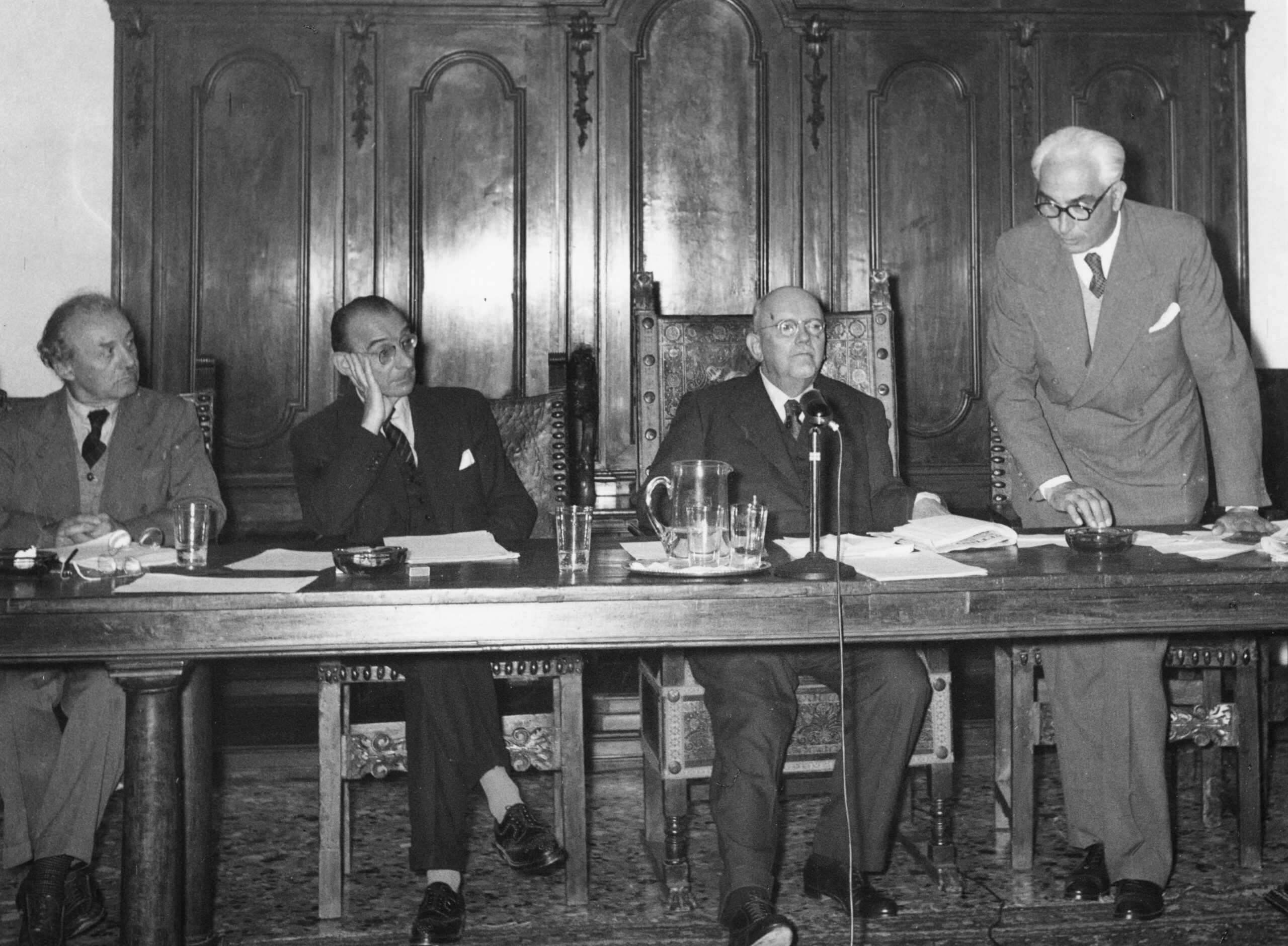
The Art History Seminars

Exactly sixty years ago, in 1954, thanks to a group of art historians, led by Giuseppe Fiocco and including experts of the calibre of Sergio Bettini, Carlo Anti and Piero Zampetti, and with Vittorio Cini’s resolute support, the Fondazione Giorgio Cini Institute of Art History was created and immediately revealed its potential to
become a major international study and research centre. The newly founded institute was officially unveiled in October of the same year, during the historic conference on Figurative Art and Abstract Art. The Institute of Art History’s critical, interdisciplinary approach and diversified methodological orientations soon made its
significance and primary aim clear. It was intended to play a leading role not only in academic research into the art of the past, but also in the debate on contemporary art by promoting international studies and major exhibitions. To celebrate the creation of the institute, the Fondazione Giorgio Cini has organised for 30-31 October an event that will explore the great depth and significance of that historic conference by placing it at the centre of the first edition of The Art History Seminars.

The first day will focus on the state of art criticism with reference to the leading players and speake rs at the historic 1954 meeting, such as Gino Severini,
Enrico Prampolini, Emilio Vedova, Felice Carena and Berto Lardera. There will also be a focus on the main issues discussed at that conference with the aim of describing the ensuing historiographical developments as well as current critical prospects. This also implies the ambition of creating a series of comparisons concerning the current state of art historical research methodologies applied to 20th-century art and criticism. Some of the topics addressed will include French, Italian and German post-war critics (bearing in mind the historic conference participants); the 1954 Venice Biennale; the abstract-figurative debate; the “Group of Eight”; the “New Front of the Arts”; the second wave of Futurism and the role of Severini; American abstract art and forays into post-war sculpture; 1950s Europe and the currents of Informel, Spatialism and Neo-avantgardes; plus various other subjects that arose at the conference.

The second day, organised in collaboration with the Palazzo Grassi, will involve a debate on issues, orientations, destinies, visions and projects associated with the discipline of art history. This will be a kind of critical think-tank aimed at producing ideas for further thought on cultural policies. On the second day there will also be a series of documentary films on major 20th-century art historians.

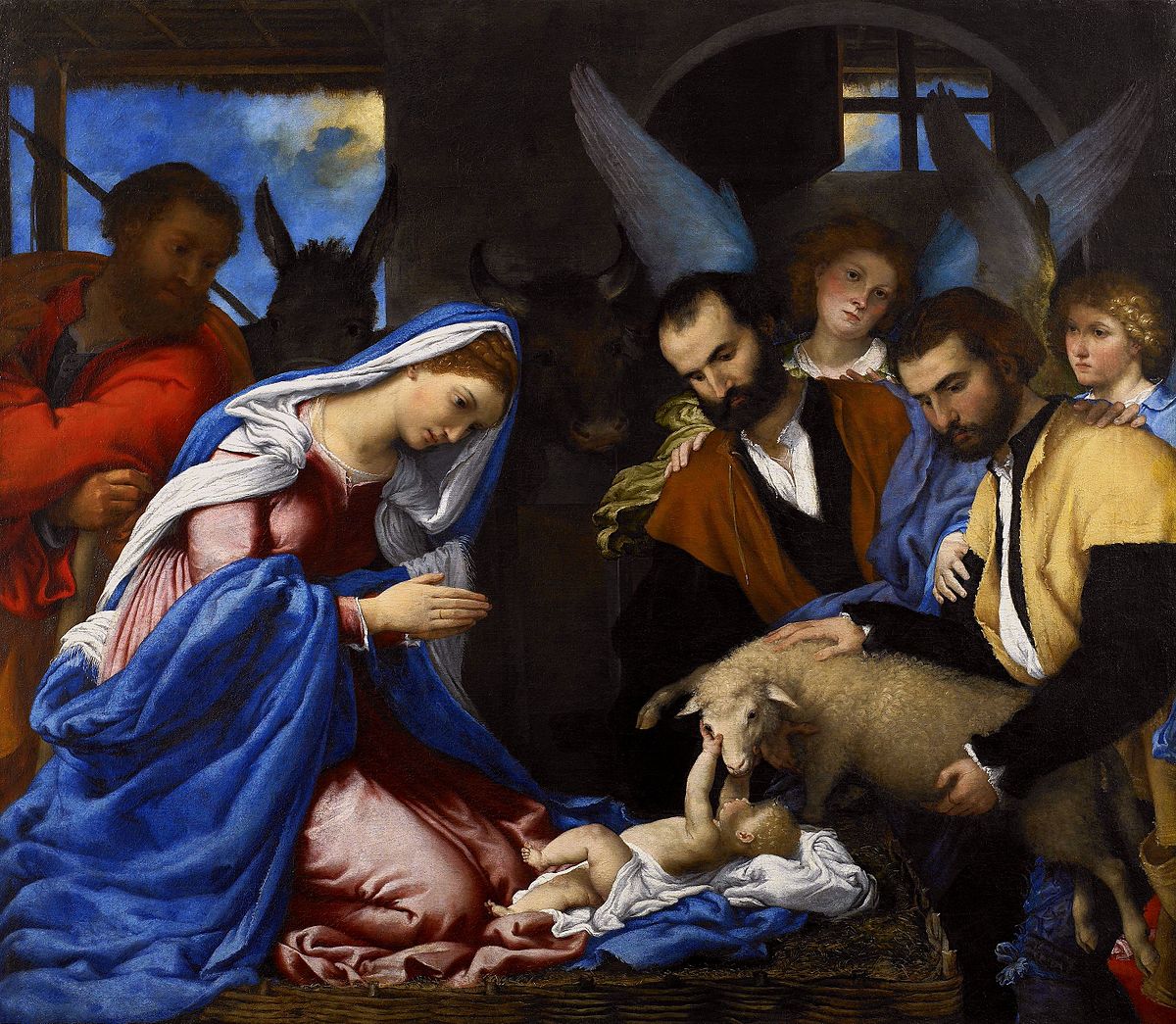
A Guest at the Palace | “Adoration of the Shepherds” by Lorenzo Lotto

The Guest at the Palace initiative, promoted by the Art History Institute of the Fondazione Giorgio Cini, was created through collaborations with some of the most prestigious Italian and international museum institutions. Conceived to temporarily enrich the museum holdings of Galleria di Palazzo Cini, the project features the exhibition of particularly important artworks granted on extraordinary loan and hosted for several months in the historic residence of Vittorio Cini, which houses the masterpieces of his remarkable art collection.

From September 5 to November 2, 2014, the Galleria di Palazzo Cini hosted Adoration of the Shepherds by Lorenzo Lotto (Venice, c. 1480 – Loreto, 1556–1557), on loan from the Musei Civici di Brescia and considered one of the masterpieces of the artist’s mature period. The initiative was promoted by the Art History Institute in collaboration with Fondazione Brescia Musei and the Pinacoteca Tosio Martinengo.

The relationship established with the city of Brescia is rich in significance, as it was historically a place of encounter and exchange between Venetian and Lombard artistic cultures, as well as with its Pinacoteca, which preserves some of the most important examples of the great Lombard and Brescian painting tradition. The presence of the Adoration of the Shepherds at Palazzo Cini represented a stage in an ideal itinerary of Lorenzo Lotto’s works in Venice, connecting nearby institutions and sites such as the Gallerie dell’Accademia with the extraordinary Portrait of a Young Man, the Church of Santa Maria dei Carmini with the altarpiece depicting Saint Nicholas in Glory with Saints, and finally the Basilica dei Santi Giovanni e Paolo with the other magnificent altarpiece representing The Alms of Saint Antoninus.

[accordion][/accordion]
[accordion_entry title=”Adoration of the Shepherds”]

The painting Adoration of the Shepherds was acquired by Count Paolo Tosio in 1825 and is regarded as one of the masterpieces of the Brescian collection.

Enclosed within a setting defined by simplified architectural lines, forming a shed-like stable compressed by shadows gathered in its recesses into a backdrop of pure geometry, the group of figures is arranged to express the theme of the Adoration of the Christ Child by Mary and the shepherds. Here, the image of the recognition of Christ’s divinity is combined with the older iconographic tradition of the Virgin of Humility.

In the detail of Mary adoring the Child, kneeling on the very same moss-covered basket in which the Infant lies, one may perceive an allusion to the debate concerning Mary’s role as co-redeemer in the plan of eternal salvation — a central issue in the religious disputes surrounding Catholic reform and the Council of Trent. Joseph, portrayed as a protective father figure, occupies the background, from which the ox and the donkey emerge within the evening atmosphere.

[/accordion_entry]
[accordion][/accordion]

[accordion][/accordion]
[accordion_entry title=”Opening hours and admission”]

It is open every day (except Wednesdays) from 11:00 a.m. to 7:00 p.m.

[/accordion_entry]
[accordion][/accordion]

[accordion][/accordion]
[accordion_entry title=”All editions”]

May 24 – July 21, 2014

Portrait of a Young Man with a Lute by Agnolo Bronzino


September 5 – November 2, 2014

Adoration of the Shepherds by Lorenzo Lotto 


June 17 – September 28, 2015

The Madonna of Pontassieve by Beato Angelico


September 19 – November 15, 2015

Capriccio with a Small Square by Francesco Guardi  


April 8 – June 6, 2016

Saint Mark by Andrea Mantegna


May 28 – November 1, 2021

Saint George and the Dragon by Paolo Uccello


July 15 – October 15, 2023

Warsaw, Church of the Holy Cross by Bernardo Bellotto


May 11 – July 16, 2023

Cleopatra by Artemisia Gentileschi


May 14 – September 8, 2025

The Crucified Christ by Antoon van Dyck


June 18  — September 27, 2026

Minerva Infuses the Soul into the Human Figure Modeled in Clay by Prometheus

[/accordion_entry]
[accordion][/accordion]

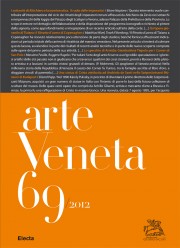
«Arte Veneta» 69 (2012)

Szilárd Papp, Un Cristo attribuito ad Andriolo de Santi nello Szépmüvészeti Múzeum di Budapest

Ettore Napione, I sottarchi di Altichiero e la numismatica. Il ruolo delle imperatrici

Matthias Wivel, Troels Filtenborg, Un’opera giovanile di Tiziano: il Ritratto d’uomo di Copenaghen

Simona Carotenuto, Nuovi documenti sui rapporti di Francesco Solimena con la committenza veneta e una proposta per l’Apollo e Dafne

Massimo Favilla, Ruggero Rugolo, Lo specchio di Armida: Giambattista Tiepolo per i Corner di San Polo

Andrea Tomezzoli, Giambettino Cignaroli, Leda e i re di Polonia

Notices

Sören Fisher, Marco Mantova Benavides e l’allegoria della Pecunia: una nuova interpretazione del dipinto di Gualtiero Padovano nella Gemäldegalerie Alte Meister di Dresda

Mattia Vinco, Un San Michele arcangelo di Nanni di Bartolo nel monastero femminile di San Michele di Campagna a Verona

Samo Štefanac, Vere da pozzo veneziane all’Avana

Sara Menato, Per la provenienza di un Cristo benedicente di Giovanni Bellini dal complesso agostiniano di Santo Stefano a Venezia

David McTavish, Due nuovi dipinti mitologici di Giuseppe Porta detto Giuseppe Salviati

Luca Siracusano, Non Campagna ma Cavrioli. Una Madonna veneziana a Londra

Damir Tulić, Giusto Le Court e il Monumento Pesaro ai Frari: un bozzetto per i “quattro bellissimi Affricani”

Luca Fabbri, Un inedito Langetti in territorio veronese

Maria Chiara Sassu, Giovanni Antonio Zonca: sulle tracce dell’artista

Nina Kudiš, Damir Tulić, Una pala d’altare di Giuseppe Nogari a Favaro Veneto

Archive papers

Bruno Chiappa, Precisazioni documentarie sui lapicidi Da Castello e sull’attività di Francesco nel cantiere di San Giorgio in Braida a Verona

Silvia Merigo, Novità archivistiche su Pietro Bellotti

Davide Dossi, La Galleria Curtoni di Verona: la sua dispersione e qualche recupero

Lino Moretti, Note minime per Federico Bencovich

Fabien Benuzzi, Documenti e precisazioni attributive riguardanti Giovanni Gai

Massimo Favilla, Ruggero Rugolo, Un’aggiunta a Giambattista Tiepolo per i Corner di San Cassiano

Raquel Gallego, Sul possibile apprendistato di Francisco de Goya y Lucientes presso Ca’ Farsetti a Venezia

Restorations

Eleonora Lanza, Sul Ratto delle Sabine di Giambattista Tiepolo

In memoriam

Giovanna Valenzano, Italo Furlan

Tiziana Franco, Giovanni Lorenzoni

ebook Bibliografia dell’arte veneta (2011)

edited by Daniele D’Anza


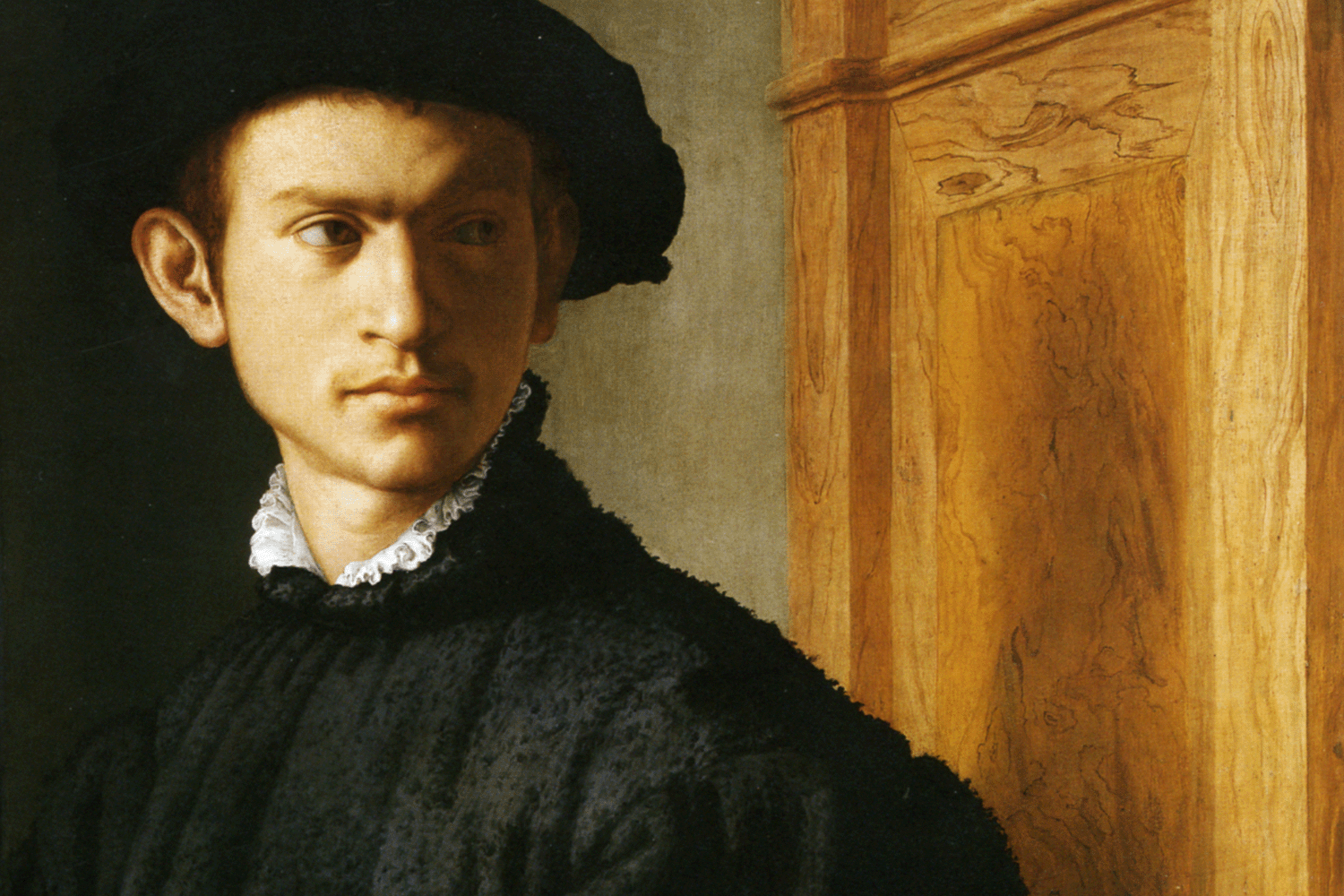
A Guest at the Palace | “The portrait of a young man with a lute” by Agnolo Bronzino

The Guest at the Palace initiative, promoted by the Art History Institute of the Fondazione Giorgio Cini, was created through collaborations with some of the most prestigious Italian and international museum institutions. Conceived to temporarily enrich the museum holdings of Galleria di Palazzo Cini, the project features the exhibition of particularly important artworks granted on extraordinary loan and hosted for several months in the historic residence of Vittorio Cini, which houses the masterpieces of his remarkable art collection.

The portrait of a young man with a lute by Agnolo Bronzino (Monticelli, Florence, 17 November 1503 – Florence, 23 November 1572), from the Uffizi Gallery, inaugurated the series of Guests at the Palace works at Palazzo Cini, in the year of the reopening of Palazzo Cini at San Vio.

The painting established a perfect dialogue with the portraiture of the master Pontormo, especially with the Double Portrait of Friends, which was simultaneously displayed in the major exhibition Pontormo and Rosso Fiorentino. Diverging Paths of the “Maniera” held at Palazzo Strozzi (Florence, 8 March – 20 July 2014). This collaboration between the Fondazione Giorgio Cini, the Uffizi Gallery, and the Fondazione Palazzo Strozzi created an ideal bridge between the two great cities of art: Venice and Florence.

[accordion][/accordion]
[accordion_entry title=”The portrait of a young man with a lute“]

The portrait of a young man with a lute (1532–1534), in which Agnolo Bronzino portrays the poet and musician Giovanni Battista Strozzi, is a fascinating work from the Florentine painter’s youth and represents a supreme example of Mannerism understood as an intensification of classical norms and Renaissance visual codes.

The painting from the Uffizi Gallery, an exceptional “guest” for the reopening of Palazzo Cini at San Vio, establishes a perfect dialogue with the portraiture of the master Pontormo, especially with the Double Portrait of Friends, one of the masterpieces of the Tuscan Renaissance from the Cini Collection, with which it shares profound cultural affinities and subtle symbolic relationships. Following the logic of these affinities, the Double Portrait is now displayed in the remarkable exhibition Pontormo and Rosso Fiorentino. Diverging Paths of the “Maniera” held at Palazzo Strozzi (Florence, 8 March – 20 July 2014), as part of a collaboration between the Fondazione Giorgio Cini, the Uffizi Gallery, and the Fondazione Palazzo Strozzi, creating an ideal bridge between the two great cities of art: Venice and Florence.

[/accordion_entry]
[accordion][/accordion]

[accordion][/accordion]
[accordion_entry title=”Opening hours and admission”]

It is open every day (except Tuesdays) from 11:00 a.m. to 7:00 p.m.

[/accordion_entry]
[accordion][/accordion]

[accordion][/accordion]
[accordion_entry title=”All editions”]

May 24 – July 21, 2014

Portrait of a Young Man with a Lute by Agnolo Bronzino


September 5 – November 2, 2014

Adoration of the Shepherds by Lorenzo Lotto 


June 17 – September 28, 2015

The Madonna of Pontassieve by Beato Angelico


September 19 – November 15, 2015

Capriccio with a Small Square by Francesco Guardi  


April 8 – June 6, 2016

Saint Mark by Andrea Mantegna


May 28 – November 1, 2021

Saint George and the Dragon by Paolo Uccello


July 15 – October 15, 2023

Warsaw, Church of the Holy Cross by Bernardo Bellotto


May 11 – July 16, 2023

Cleopatra by Artemisia Gentileschi


May 14 – September 8, 2025

The Crucified Christ by Antoon van Dyck


June 18  — September 27, 2026

Minerva Infuses the Soul into the Human Figure Modeled in Clay by Prometheus

[/accordion_entry]
[accordion][/accordion]

Palazzo Cini, the Gallery. Tuscan and Ferrarese Masterpieces from the Vittorio Cini Collection

24 May – 2 November 2014

Palazzo Cini, the Gallery.

Tuscan and Ferrarese Masterpieces from the Vittorio Cini Collection

 For the sixtieth anniversary of the Institute of Art History, the Palazzo Cini at San Vio will open to the public again

 Thanks to a partnership with Assicurazioni Generali, already a patron of the Giorgio Cini Foundation, from May to November visitors will be able to admire the palace with its marvellous collection of Tuscan and Ferrarese paintings, including works by Giotto, Guariento, Botticelli, Filippo Lippi, Piero di Cosimo and Dosso Dossi. 

In the sixtieth anniversary year of the creation of the Institute of Art History, directed by Luca Massimo Barbero, the Giorgio Cini Foundation has decided to open up the exhibition rooms in the Palazzo Cini from 24 May to 2 November 2014 as part of a renewed cultural policy. The main partner in the initiative is Assicurazioni Generali.

“For the reopening of the Palazzo Cini” – comments the Director of the Institute of Art History  – “the Cini Foundation has begun a series of renovation works to improve the lighting and conservation conditions for the paintings as well as making the exhibition itinerary smoother while maintaining the unique, intimate domestic dimension of the museum house. Moreover, to further knowledge about these masterpieces and to give the works housed in the Palazzo Cini their full historical significance, in keeping with the art history statute, the Institute has set up a study programme devoted to the paintings and art objects involving a new generation of art historians; the results will be published in 2015.”

“Generali is an international group with a powerful identity and deep cultural roots” – explains Simone Bemporad, the Generali Group’s Director of Communications and External Relations. “The lion of St Mark represents an inextricable symbolical link with Venice and its history. For us working alongside the Cini Foundation in a project to showcase and develop part of its remarkable artistic heritage is a reason to be proud and at the same time means paying homage to our tradition and reaffirms our century-old mission to take care of valuable things.”

The idea is to provide the city with the opportunity – for at least six months a year – of seeing the marvellous Tuscan and Ferrarese masterpieces kept in the splendid gallery. At the same time, the Institute of Art History has begun an important new study programme on the Palazzo Cini works, which will again be available for scrutiny by the international scholarly community.

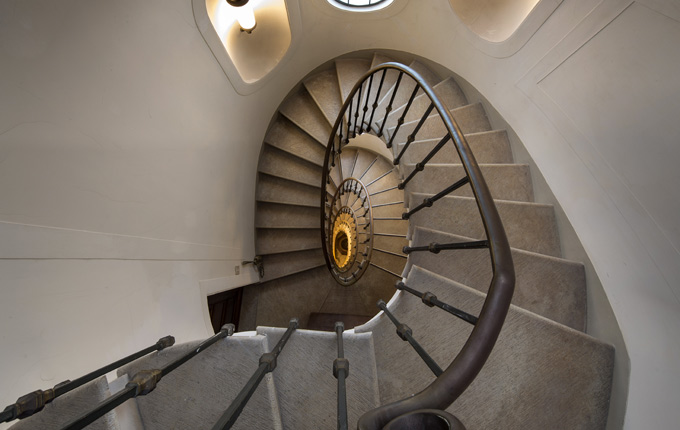
Palazzo Cini, the extraordinary museum house in which Vittorio Cini once resided was presented to the Foundation by his heirs exactly thirty years ago. Situated in the Venetian “Museums Mile”, between the Accademia, the Peggy Guggenheim collection and the Punta della Dogana, the palace houses some remarkable works by Giotto, Guariento, Botticelli, Filippo Lippi, Piero di Cosimo and Dosso Dossi.

The rooms on the piano nobile are fitted out with period furniture and art objects reflecting the original character of the residence and personal taste of the great collector. The around thirty Tuscan paintings exhibited in these rooms were presented to the Giorgio Cini Foundation in 1984  by Yana Cini, along with with the part of the palazzo accommodating them. Beside this group, with outstanding works such as the Judgement of Paris by Sandro Botticelli and the Madonna and Child with Two Angels by  Piero di Cosimo, there are also paintings from the Renaissance School of Ferrara (including Saint George by Cosmè Tura), which were loaned permanently in 1989 by Ylda Cini Guglielmi di Vulci. The gallery also boasts significant examples of applied arts, such as the complete porcelain table service made by the 18th-century Venetian manufactory of Cozzi, ivory plaques and caskets by the Workshop of the Embriachi, Renaissance enamels, jewellery, terracotta sculptures, sideboards, an 18th-century sedan chair and some precious cassoni, including a rare mid-14th-century Sienese dowry chest.

One of the Tuscan Renaissance masterpieces in the Palazzo Cini collection, the Portrait of Two Friends by Pontormo, will be on show in a major exhibition: Pontormo and Rosso Fiorentino. Diverging Paths of Mannerism (Florence, Palazzo Strozzi, 8 March – 20 July 2014). The loan is part of a significant collaboration between the Giorgio Cini Foundation, the Galleria degli Uffizi and the Fondazione Palazzo Strozzi involving exchanging works between institutions and thus creating a cultural bridge between the two great art cities of Venice and Florence.


Main partner  Assicurazioni Generali.

 

generali_palazzo_cini 


Assicurazioni Generali fully identifies with the commitment to support and hand down to the next generation our inestimable cultural heritage. The reopening of the Palazzo Cini at San Vio is an example of this and has a hallmark value for the company as it continues to pursue its centuries-old mission of caring for things of value.


By opening to the public on a lasting basis such a rare and precious legacy as the Palazzo Cini, Generali wishes to offer the opportunity for people to discover, become familiar with and cherish its fascinating treasure, consisting of the gallery, furnishings and art objects. They reflect the original character of the great collector Vittorio Cini’s home and personal taste. We are thus also afforded a look behind the wings of the Cini Foundation’s farsighted culture operation on the island of San Giorgio, now celebrating its sixtieth anniversary.


Through its supporting actions, Generali interprets its role as a patron of the arts in an innovative way by enabling projects to be implemented and by providing new opportunities for exchanges with the public as well as creating value and stimuli. All this is done by communicating in the unique, instantly recognisable language that is the Group’s distinctive feature in the over sixty countries in which it operates. Generali’s commitment to Venice is highly meaningful. The Lion of Saint Mark is an indelible symbolic link with the lagoon city and its history. Since its foundation, the company has been present in Venice and shares the same multicultural international tradition while supporting the city’s principal artistic, musical and literary institutions. By emphasising the promotion and diffusion of culture, Generali demonstrates its conviction that bringing people into contact with art, music and literature is a crucial factor in personal development and stimulates innovation.



coemar logo ok


The collaboration between the Giorgio Cini Foundation, Master Audio and Coemar Lighting was organised ahead of the reopening of the Palazzo Cini. The aim was to equip the rooms of the Gallery with suitable lighting systems able to preserve the typical atmosphere of the museum house and to showcase through an unobtrusive but effective light the precious works in the Vittorio Cini collection, now part of the heritage belonging to the Foundation named after his son Giorgio.

The Gallery’s innovative lighting system is the result of collaboration between Maurizio Schicheri, the founder of Master Audio, a company specialised in designing lighting for exhibition spaces, and Carlo Alberto Pini and Patrik Menozzi, lighting engineers with Coemar Lighting, which for over eighty years has designed, produced and marketed professional lighting products. The project relied on the expert collaboration of Marina Vio, a lecturer at the Venice University Institute of Architecture (IUAV), who had previously studied the lighting for the enamels in the Cini Collection.

The work at the Palazzo Cini was focused on improving the colour perception of the works and objects on show. For this purpose, the designers made use of the results of a joint study conducted by IUAV and the University of Padua, which subsequently became the basis for the prototype lighting system specially made for the Gallery.

The principal new feature in this lighting system is the innovative use of LED sources. The richness of the Cini Collection and the variety of materials in the works on show presented a problem that was difficult to solve: each material reflects light in a different way and the colours can only usually be brought out if the objects are lit singularly with a customised light. With so many varied types of objects (paintings, painted panels, ivories, and finely decorated enamelled metal plates), however, a single lighting system would have impoverished the value of the works. On the contrary, the lighting fixtures developed for the Palazzo Cini make it possible to separate the light sources through a combination of different types of LED. When combined and regulated individually, they can provide variations of white from warm to cold, which can be modified according to the “needs” of each individual work, allowing visitors to admire the masterpieces in the Palazzo Cini in a light that is as close to natural as possible.
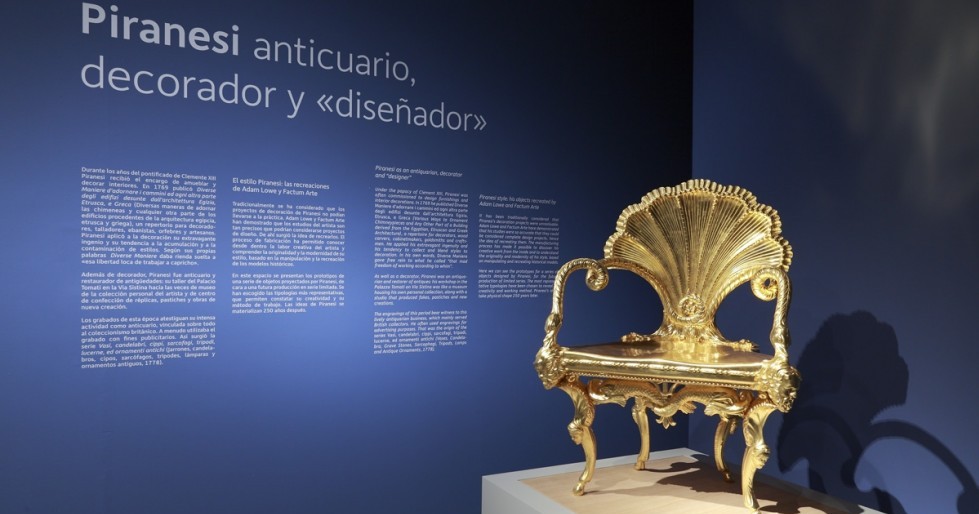
Las Artes de Piranesi. Arquitecto, grabador, anticuario, vedutista y diseñador

After being critically acclaimed – Nobel prize-winner Mario Vargas Llosa described it as an “extraordinary” exhibition – and enjoying considerable public success (over 150,00 visitors), The Arts of Piranesi. Architect, printmaker, antiquarian, vedutista, designer, goes to Barcelona, where it is due to run from 5 October to 20 January 2013 at the Caixa Forum, headquarters of the Obra Social La Caixa, the organisation which made the Spanish tour possible.
Conceived by architect Michele De Lucchi and produced by the Giorgio Cini Foundation and Adam Lowe’s Factum Arte studio, the exhibition explores the many and varied activities of Giambattista Piranesi (Venice 1720 – Rome 1778) in an itinerary featuring prints from the complete works held in the Giorgio Cini Foundation graphic collections and a series of modern objects created in Piranesi’s language and style.
They include a 3D fi lm of the Carceri d’Invenzione and eight original objects made by Factum Arte starting from Piranesi prints (two tripods, a vase, a chair, a candelabrum, an altar, a coffee pot and a fi replace complete with fi re furniture). The exhibition also features views of Rome, Tivoli and Paestum by  photographer Gabriele Basilico.

Penelope’s Labour: Weaving Words and Images

Conceived as a companion to the exhibition of the same name, this catalogue explores the enduring significance of tapestry as an artistic language. Organised by the Fondazione Giorgio Cini in collaboration with the Madrid-based studio Factum Arte, the exhibition investigates the intersection between historical tradition and contemporary practice in textile art.

Through scholarly essays and interdisciplinary perspectives, the volume examines how this centuries-old medium continues to provide artists with a powerful tool to reflect on the complexities of the present. The featured works range from a rare fifteenth-century depiction of the Siege of Jerusalem to Azra Akšamija’s textiles addressing ethnic cleansing in the Balkans, and the contemporary visions of Grayson Perry and Marc Quinn.

The publication includes an introduction by Pasquale Gagliardi and contributions from Jerry Brotton, Nello Forti Grazzini, Annemarie Sauzeau Boetti, Jon Thompson, Adam Lowe and Iván de la Nuez. Rich in visual documentation and critical reflection, the catalogue repositions tapestry at the heart of today’s cultural and artistic discourse.